

Open a Free Demat Account !
₹0 AMC & Account Opening Fee
Stocks in India: Prices, Sectors & Investment Guide

 Last Updated: 21 September, 2026
 12 min read




00:00 / 00:00


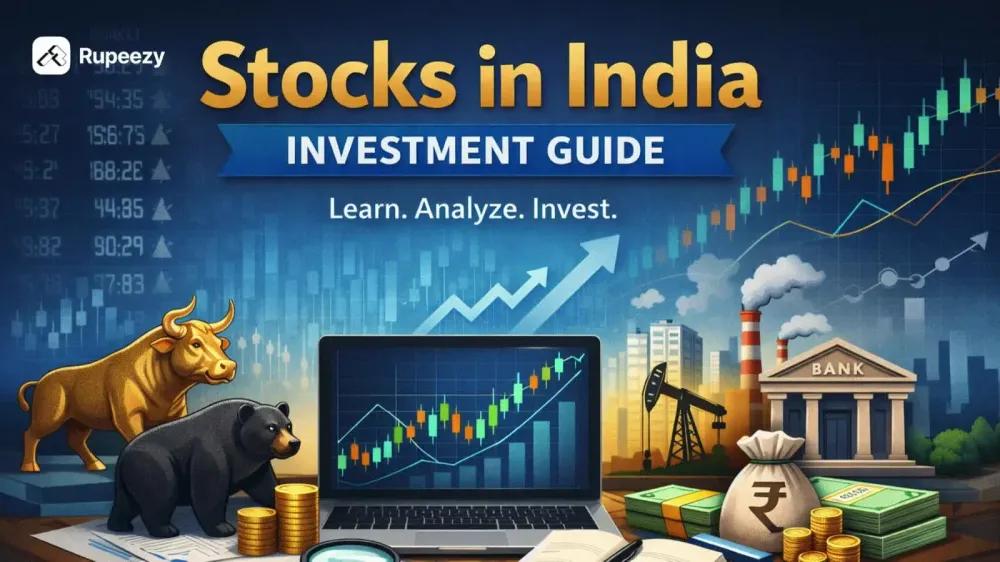
The stock market in India is rapidly becoming a popular investment option for ordinary people. However, before investing in Indian stocks, it's crucial to understand how stock prices are determined, which sectors are performing well, and how to conduct proper analysis. In this blog, we will explain stock prices, analysis, sectors, and investment guidelines simply and reliably.

What Are Stocks in India?
Stocks or shares represent ownership in a company. When a company needs to raise money to expand its business, it sells small portions of itself to the public. These portions are called shares or stocks.
What does buying a stock mean?
When you buy a share of a company, you become a small owner of that company. If the company makes a profit and grows, the value of your shares also increases.
Example: Let's say you bought a company's share for Rs.100. After some time, the company performed well, and the share price rose to Rs.150. This means you made a profit of Rs.50.
Indian Stock Market Overview
The Indian stock market is where shares of companies are bought and sold. When a company needs money to expand its business, it sells shares to the general public. Investors buy and sell these shares. Share prices are determined by supply and demand in the market.
The Role of NSE and BSE
There are two major stock exchanges in India:
NSE (National Stock Exchange) : This is India's largest and most modern electronic exchange, where most of the trading takes place.
BSE (Bombay Stock Exchange) : This is Asia's oldest stock exchange and has thousands of companies listed on it.
Both these exchanges provide investors with a safe and transparent platform for buying and selling shares.
What do Sensex and Nifty represent?
Indices are created to understand the state of the stock market.
Sensex: This shows the performance of 30 large and well-established companies listed on the BSE.
Nifty 50: This is an index based on 50 leading companies listed on the NSE.
If the Sensex or Nifty goes up, it means that the major companies in the market are performing well.
Stock Prices in India: How They Are Decided
Before investing in the stock market, it's crucial to understand what a stock price is and how it is determined. Many new investors invest simply by looking at the share price, while in reality, there are several important factors behind the price. In this section, we will understand all the important aspects related to share prices in detail.
What is a Stock Price?
A stock price is the current price at which a company's share is being bought or sold on the stock exchange. This price constantly fluctuates during market hours as shares are continuously being bought and sold. In simple terms, the stock price is the price at which buyers and sellers agree to trade a share.
How are share prices determined?
In India, share prices are not determined by any institution or the government.
These prices are entirely based on market demand and supply.
When the demand for a share is high and there are fewer sellers, its price increases.
When there are more sellers and fewer buyers, the price falls.
This is the rule that determines the price of every share in the Indian stock market.
Major factors affecting demand and supply
Company's Financial Performance: A company's profits, sales, and future growth directly impact its share price.
Example: If a company announces better-than-expected quarterly results, investor confidence increases, and the share price may rise.
News and Significant Events: Share prices are influenced by various news and events, such as:
New orders or contracts
Government policies and budgets
Mergers and acquisitions
Regulatory decisions
Example: If an infrastructure company secures a large government project, its share price may see a significant increase.
Economic Conditions: Interest rates, inflation, and economic growth also affect stock prices.
Rising interest rates put pressure on the stock market.
Strong economic growth leads to increased company earnings and higher share prices.
Investor Sentiment: The stock market is driven not only by data but also by investor psychology and emotions.
Positive sentiment - Increased buying - Price increases
Negative sentiment - Increased selling - Price decreases
This is why even shares of good companies sometimes experience temporary declines.
Difference between Market Price and Company Value
It is crucial for new investors to understand the difference between:
Market Price: The current market price of a share
Company Value (Intrinsic Value): The true worth of the company, based on factors such as its business model, earnings, and future prospects
A share can only be considered cheap or expensive when its price is compared to its intrinsic value.

How Stock Prices Rise or Fall in India
Stock prices in the stock market don't change randomly. There are solid reasons behind every rise and fall. If someone wants to truly understand the stock market, whether for trading or long-term investing, it's crucial to understand why stock prices rise or fall.
For investors who prefer a disciplined approach to long-term stock investing, a stock SIP can help invest a fixed amount at regular intervals and gradually build an equity portfolio.
Demand and Supply – The real basis of a share price :
The most fundamental rule of the stock market is supply and demand.
When there are more buyers than sellers of a stock, the price increases.
When there are more sellers than buyers, the price decreases.
This rule applies to every stock, regardless of whether the company is small or large.
Example: Let's say a company's share is trading at Rs.100. Suddenly, the company receives a large order. Now, more people want to buy, but there are fewer sellers. More buyers, fewer sellers.The price goes up from Rs.100 to Rs. 115-Rs. 120.
Company Performance :
The price of any stock follows the company's business performance over the long term.
Profits are increasing
Sales are growing
Debt is under control
This increases investor confidence, and the stock price goes up.
Example: If a company's profits have been consistently increasing for the past 3 years, investors consider it future-proof.
More investment - Higher demand - Price rise.
Future Expectations :
The stock market always prices in the future in advance.
If investors believe that:
The company will enter new markets
New products will be launched
Profits will increase in the coming years
Then the stock price starts rising even now.
Example: Many companies in the EV sector were initially operating at a loss, but their share prices rose due to expectations of future growth.
News and Events :
News plays a very important role in trading.
Positive News:
Good quarterly results
New contract
Government support
Negative News:
Loss
Regulatory problem
Legal issue
Example: If a pharmaceutical company receives drug approval, the price can jump by 10–15% even within a single trading day.
News and Events – Short-Term Price Movement
News plays a very important role in trading.
Positive News:
Good quarterly results
New contract
Government support
Negative News:
Loss
Regulatory problem
Legal issue
Example: If a pharmaceutical company receives drug approval, the price can jump by 10–15% even within a single trading day.
Market Sentiment – Fear and Greed
The market is driven not only by numbers but also by emotions.
Fear People sell in a panic Price falls
Greed People buy even at high prices Price rises rapidly
Example : During Covid, even the shares of good companies fell due to fear, even though their businesses were strong.
Big Players (Institutional Investors)
Large investors such as:
Mutual Funds
Foreign Institutional Investors (FIIs)
Insurance companies
When they buy or sell in large quantities, the price moves rapidly.
Example : If FIIs are continuously buying a particular stock, retail traders also follow suit, and the price goes up.
Trading Activity and Technical Levels
Trading activity also causes prices to move.
Buying occurs at support levels.
Selling occurs at resistance levels.
Example : If a stock has a support level of Rs.200 and buyers consistently step in at that level, the price will repeatedly bounce back up.
Volume – Does the price movement have strength?
If a stock's price is rising and the trading volume is also increasing, it means that more investors and traders are showing interest in that stock. In this situation, the price increase is considered strong and is likely to continue. However, if a stock's price is rising but the trading volume is low, it indicates that the increase is not being driven by widespread participation. Such price movements are less reliable, and the price may reverse and fall.
Overall Market Trend
Sometimes, it's not just individual stocks, but the entire market that controls the price.
Bull market : Most stocks go up
Bear market : Even good stocks fall
Example : If the Nifty is falling, even the stock of a strong company can fall in the short term.
Short-Term Trading vs. Long-Term Investing
Trading : News, volume, and sentiment have a greater impact.
Investing : Business quality and growth matter more.
The reasons for price movements change with time.
Different Stock Market Sectors in India
The Indian stock market is divided into several different sectors. Each sector represents a specific part of the country's economy.
With so many sectors and stocks to track, a stock market heatmap can help investors quickly compare market performance and identify which sectors and stocks are gaining or losing strength. This can be a useful starting point before conducting deeper stock analysis.
Investors can explore stock market sectors to understand different industries and compare sector-wise opportunities before selecting stocks.
List of Major Sectors in the Indian Stock Market
Banking and Financial Services
Information Technology (IT)
Pharmaceuticals and Healthcare
FMCG (Fast Moving Consumer Goods)
Automobiles and Auto Parts
Energy and Power
Oil and Gas
Infrastructure
Capital Goods
Metals and Mining
Real Estate
Telecom
Cement
Chemicals
Textiles
Consumer Durables
Media and Entertainment
Agriculture and Agri-Based Industries
PSUs (Public Sector Undertakings)
Defense and Aerospace
EV and Renewable Energy
What Is Stock Analysis and Why It Matters
Stock analysis means thoroughly examining a company and its shares before investing in them. It involves understanding what the company does, its earnings, and the factors that can cause its share price to rise or fall. In simple terms, stock analysis is a method of making informed decisions rather than relying on guesswork.
Why is stock analysis important before investing?
When someone buys shares without analysis, they are simply relying on luck. Stock analysis helps investors understand whether the shares they are investing in are safe or not. Proper analysis reduces the risk of losses and increases the likelihood of achieving better returns in the long run.
Difference between short-term and long-term analysis
Short-term analysis is typically done for trading, focusing on share price, charts, and market movements. Long-term analysis, on the other hand, is for investing and involves examining the company's business, profitability, and future growth prospects. The approach to analysis changes depending on the time horizon, but the goal of both is to make sound investment decisions.
How to Invest in Stocks in India: Step-by-Step Guide
Step 1: Define Your Investment Goals
Before starting to invest in the stock market, it's crucial to decide whether you want to invest for the short term or the long term. Also, understand how much risk you can tolerate. Having clear goals makes choosing the right stocks easier.
Once you have defined your investment goals, it is important to connect your investment choices with specific financial objectives and timelines. Goal-based investment planning can help you structure your stock investments around goals such as wealth creation, buying a house, children's education, or retirement.
Step 2: Open a Demat and Trading Account
A Demat and Trading Account is necessary to buy and sell shares. This usually requires your Aadhaar card, PAN card, and bank details. Choosing a reliable stockbroker is very important. Platforms like Rupeezy offer easy account opening, a user-friendly app, and essential investment features, making it easier for new investors to get started.
Step 3: Learn and Research Before Investing
Investing without understanding can be risky. Therefore, before investing in any stock, it's essential to understand the company's business, sector, and performance. Avoid investing based on social media tips and rumors.
Step 4: Choose the Right Stocks
When choosing stocks, consider the sector the company belongs to and the strength of its business. A good company with a clear business model and stable earnings is considered a better investment.
Investors who want to buy eligible shares by paying only a portion of the total trade value upfront can also consider a [Margin Trading Facility (MTF)]. However, MTF involves interest costs and leverage, so investors should understand the risks and margin requirements before using it.
Step 5: Invest and Monitor Performance
Once you buy shares, it's important to monitor their performance periodically. This doesn't mean checking the price every day, but rather understanding whether the company is progressing towards its goals.
Common Mistakes Beginners Make in Indian Stock Market
Buying shares based solely on price : Many new investors assume that a low-priced share is cheap and therefore a good buy. However, the company's business, profitability, and future growth prospects are far more important than the share price itself. Investing based solely on price can lead to significant losses.
Trusting social media and WhatsApp tips : Most stock market tips shared on social media and WhatsApp are not based on any research. New investors often buy shares based on these tips and end up suffering losses. Every investment decision should be made based on your own understanding and knowledge.
Investing without research : Investing without understanding the company, its sector, and its performance is a major mistake. Lack of research turns investing into mere speculation, significantly increasing the risk.
Panic selling when the market falls : When the market falls, new investors often sell even good shares out of fear. This panic selling often locks in losses. Patience is crucial for long-term investing.
Overtrading : Buying and selling shares frequently in the pursuit of quick profits is called overtrading. This increases brokerage costs, leads to poor decision-making, and increases the likelihood of losses. Patience and discipline are essential in the stock market.
Conclusion
Success in the stock market doesn't come through shortcuts, but through sound understanding and patience. Knowing how stock prices are determined, how different sectors operate, and how to conduct proper analysis is crucial for every investor. If you invest thoughtfully, with discipline, and with a long-term perspective, stocks in India can become an excellent wealth-building tool for you.
FAQs
Q1. What are stocks in India?
Stocks represent ownership in a company. When you buy shares, you become a part-owner of that company.
Q2. How do stock prices change in India?
Stock prices change based on supply and demand. Increased buying pressure drives prices up, while increased selling pressure drives them down.
Q3. Is the stock market good for beginners?
Yes, the stock market can be a good option for beginners if they invest with the right knowledge and patience.
Q4. What is the difference between trading and investing?
Trading involves short-term transactions, while investing involves holding shares in good businesses for the long term.
Q5. Which sector is best for new investors in India?
The FMCG, banking, and pharmaceutical sectors are generally considered relatively safe and easier to understand for new investors.

Anupam Shukla is a finance content writer and an NISM-certified research analyst with over Seven years of trading experience. With a passion for the stock market, he simplifies complex financial concepts, making investing and trading easier for everyone. His expertise helps readers stay ahead in the ever-changing world of finance, empowering them to make smarter money moves.
Did you like this blog?
Be the first to like this blog.
The content on this blog is for educational purposes only and should not be considered investment advice. While we strive for accuracy, some information may contain errors or delays in updates.
Mentions of stocks or investment products are solely for informational purposes and do not constitute recommendations. Investors should conduct their own research before making any decisions.
Investing in financial markets are subject to market risks, and past performance does not guarantee future results. It is advisable to consult a qualified financial professional, review official documents, and verify information independently before making investment decisions.

Open Rupeezy account now. It is free and 100% secure.
Start Stock Investment

All Category