

Open a Free Demat Account !
₹0 AMC & Account Opening Fee
Understanding Intrinsic Value in Options

 Last Updated: 17 September, 2026
 7 min read




00:00 / 00:00


Summary:
| ||
If you have ever wondered why two options on the same stock are priced so differently, the answer often comes down to one concept: intrinsic value. Whether you are a beginner stepping into derivatives or an experienced trader fine tuning your strategy, understanding the meaning of intrinsic value and how it works in options trading is non negotiable. This article breaks down everything, from the basic definition and intrinsic value formula to real world examples and how it differs between shares and options.
What Is Intrinsic Value? The Core Meaning
The meaning of intrinsic value, in the context of financial markets, refers to the actual, real worth of an asset independent of its current market price. In simple terms, it is what something is truly worth based on concrete, calculable factors, not speculation or sentiment.
In options trading specifically, intrinsic value represents the immediate profit a trader would capture if they exercised the option right now. It is the portion of an option's premium that is backed by actual price movement in the underlying asset. If there is no immediate profit to be captured, the intrinsic value is zero. It can never go negative.
Intrinsic Value of an Option: Definition and Mechanics
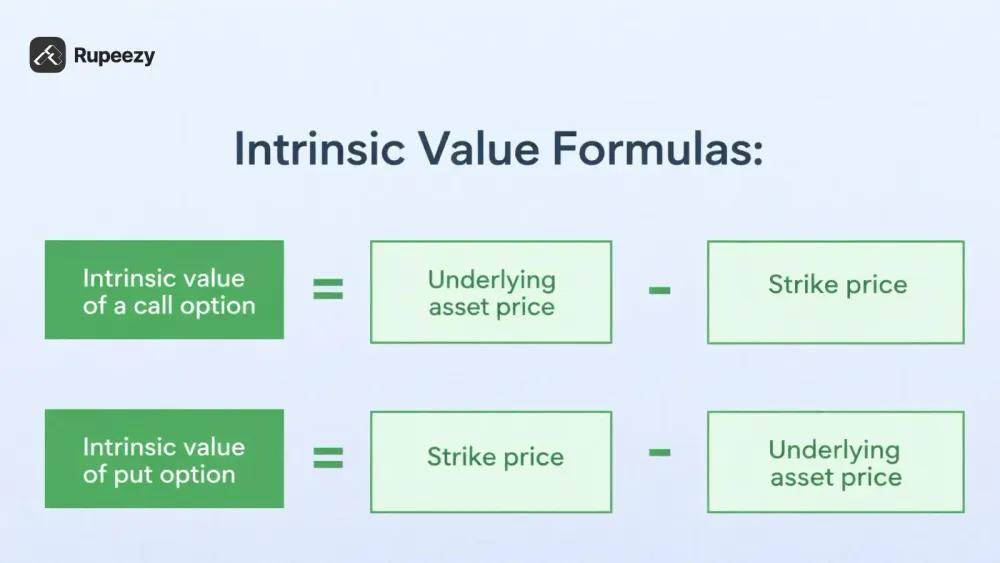
The intrinsic value of an option is calculated by comparing the current market price of the underlying asset to the option's strike price, the price at which the option holder has the right to buy or sell.
For a Call Option: Intrinsic Value = Current Market Price ? Strike Price
For a Put Option: Intrinsic Value = Strike Price ? Current Market Price
If the result of either calculation is negative, the intrinsic value defaults to zero. This is a critical rule. Options cannot have negative intrinsic value.
The relationship between the current price and the strike price determines what traders call moneyness, which classifies an option into one of three states:
In the Money (ITM): The option has positive intrinsic value. A call is ITM when the stock price is above the strike; a put is ITM when the stock price is below the strike.
At the Money (ATM): The stock price is approximately equal to the strike price. Intrinsic value is essentially zero.
Out of the Money (OTM): The option has no intrinsic value. A call is OTM when the stock trades below the strike; a put is OTM when the stock trades above the strike.
Intrinsic Value Formula: How to Calculate It
Knowing how to calculate intrinsic value is a fundamental skill for any options trader. Here is a step by step breakdown:
Step 1: Identify the current market price of the underlying stock or asset.
Step 2: Identify the option's strike price.
Step 3: Apply the appropriate formula (call or put).
Step 4: If the result is negative, set intrinsic value to zero.
The intrinsic value formula in practice:
Call Option: IV = Max(0, Stock Price ? Strike Price)
Put Option: IV = Max(0, Strike Price ? Stock Price)
The remainder of an option's total premium, the part above intrinsic value, is called time value (also known as extrinsic value). It reflects the potential for further price movement before expiry, implied volatility, and time remaining.
Intrinsic Value Example: Putting the Formula to Work
Let us walk through a clear intrinsic value example to cement your understanding.
Scenario 1: Call Option (In the Money): Imagine Reliance Industries is trading at ?2,800. You hold a call option with a strike price of ?2,600. The intrinsic value = ?2,800 ? ?2,600 = ?200. This option is ?200 in the money. If the total premium is ?250, then ?200 is intrinsic value and ?50 is time value.
Scenario 2: Put Option (In the Money): Suppose TCS is trading at ?3,500 and you hold a put option with a strike price of ?3,700. Intrinsic value = ?3,700 ? ?3,500 = ?200. Your put is ?200 in the money.
Scenario 3: Out of the Money Call: HDFC Bank is at ?1,600. You hold a call option with a strike of ?1,750. IV = ?1,600 ? ?1,750 = ??150. Since this is negative, intrinsic value = ?0. The entire premium here is time value.
These intrinsic value examples demonstrate how straightforward the concept becomes once you apply the formula in real situations.
Intrinsic Value of a Share vs. Intrinsic Value of an Option
A common point of confusion among investors is the difference between intrinsic value as applied to shares versus options. While both use the same term, they mean very different things.
The intrinsic value of a share is an estimate of what a company is fundamentally worth, based on analysis of its financials, earnings, revenue growth, assets, liabilities, and future cash flows. Common methods include the Discounted Cash Flow (DCF) model and the Benjamin Graham formula. This type of intrinsic value is subjective and can vary significantly between analysts.
The intrinsic value of an option, by contrast, is entirely objective and mathematically precise. It depends only on two numbers: the current price of the underlying asset and the strike price of the option. There is no subjectivity involved.
Intrinsic Value: Share vs Option
Feature | Options | Shares |
Intrinsic Value | Difference between underlying price and strike price; zero if out of the money | Estimated fair value based on fundamentals like earnings, assets, and growth |
Formula | Call: Intrinsic Value = Current Price ? Strike PricePut: Intrinsic Value = Strike Price ? Current Price | Intrinsic Value = EPS × (1 + g) / (r ? g) or DCF based |
Can it be negative? | No, minimum value is always zero | Can theoretically be zero |
Influenced by | Market price and strike price only | Revenue, earnings, debt, growth |
Why Intrinsic Value Matters in Options Trading
Understanding and monitoring intrinsic value gives traders a significant edge. Here is why it matters:
Premium Breakdown: It tells you exactly how much of what you are paying (or receiving) for an option is backed by real price movement versus speculation.
Exercise Decisions: An option with high intrinsic value is worth exercising. Options with zero intrinsic value (OTM) are not worth exercising at expiry.
Trade Selection: Many traders deliberately target in the money options with strong intrinsic value to reduce reliance on time value decay (theta).
Risk Management: When an option has intrinsic value, it behaves more like the underlying asset, giving you a clearer sense of your actual exposure.
Options traders should also be aware of stocks that may face restrictions on taking fresh F&O positions when applicable position limits are breached. Before entering a new trade, traders can check the F&O ban list to see which stocks are currently under such restrictions.
Professional traders track intrinsic value constantly, especially as expiry approaches, since time value erodes while intrinsic value remains intact as long as the option stays in the money.
Common Mistakes Traders Make With Intrinsic Value
Confusing intrinsic value with total premium: The total option price includes both intrinsic value and time value. Paying a high premium does not mean the option has high intrinsic value.
Ignoring time value decay: Even a deep in the money option loses time value as expiry nears. Traders who focus only on intrinsic value may overlook this erosion.
Applying the share valuation approach to options: As outlined above, the intrinsic value formula for options is completely different from how shares are valued. Mixing the two frameworks leads to flawed trading decisions.
Conclusion
Intrinsic value is one of the most foundational concepts in options trading, and once you truly understand it, a great deal of the complexity surrounding options pricing begins to make sense. At its core, it answers a simple question: if you exercised this option right now, would you make money? If yes, and by how much, that amount is the intrinsic value.
Whether you are buying a call to profit from a rising stock or purchasing a put as a hedge, always take a moment to separate the intrinsic value from the total premium you are paying. Knowing how much of your premium is backed by real price movement versus time and volatility expectation allows you to make sharper, more informed trading decisions.

Aaron Vas is a Research Analyst at Rupeezy with over four years of experience in the finance industry. He holds an M.Com. degree in Finance from St. Aloysius College. Aaron is passionate about options trading and brings in-depth expertise in stocks, technical analysis, futures and options, mutual funds, and ETFs.
Did you like this blog?
Be the first to like this blog.
Disclaimer
Investments in the securities market are subject to market risks. Read all the related documents carefully before investing. Rupeezy (SEBI RA Registration: INH000013332) provides this content for informational purposes; any securities quoted are for educational display and not as a recommendation. All charts and graphs are based on independent research and reliable sources for the period mentioned within the specific data set. Sometimes we take graphs from external sources. This communication does not promise or assure any fixed, guaranteed, or indicative returns to any client. For our complete registered office address, Member ID, and full SEBI registration details, please refer to our official website.
The content on this blog is for educational purposes only and should not be considered investment advice. While we strive for accuracy, some information may contain errors or delays in updates.
Mentions of stocks or investment products are solely for informational purposes and do not constitute recommendations. Investors should conduct their own research before making any decisions.
Investing in financial markets are subject to market risks, and past performance does not guarantee future results. It is advisable to consult a qualified financial professional, review official documents, and verify information independently before making investment decisions.




All Category