

Open a Free Demat Account !
₹0 AMC & Account Opening Fee
India-US Tariff Deal: Latest Updates and Official Statements

 Last Updated: 03 September, 2026
 5 min read




00:00 / 00:00


The India-US tariff deal is gaining attention again. This is the time when the questions around the US tariff on India are increasing rapidly. Over the years, various shifts in the trade policy have occurred. Some were in favour of the businesses in India, while others were not.
But as we move forward, it is important to have clarity on tariffs. So, read this report to learn the key details and understand what is happening around you.


Core Tariff Changes Announced
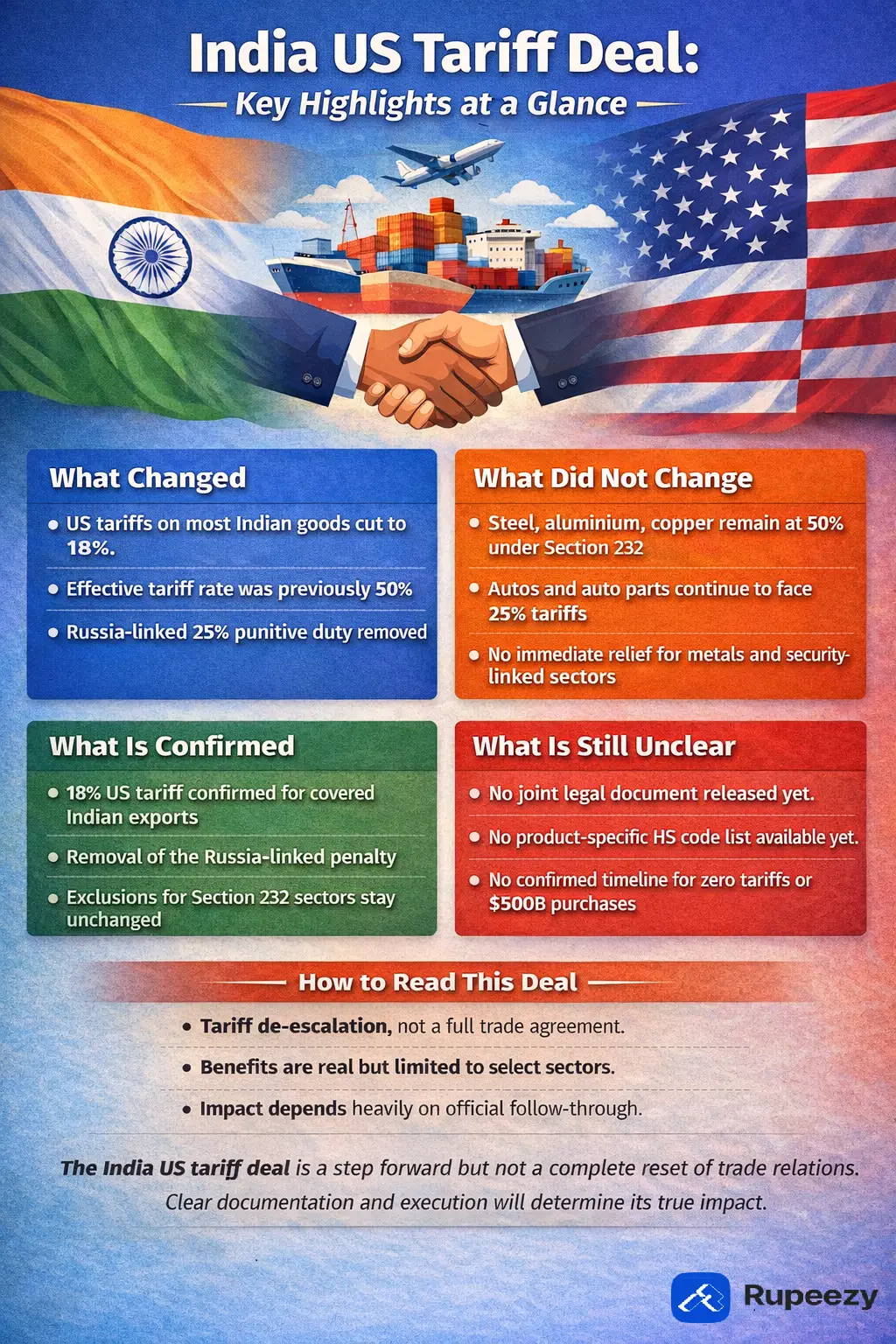
The India-US tariff deal marks a major shift from the elevated duties seen in 2025. Under the new framework, the US tariff on India has been reduced to 18% on most covered goods. Earlier, tariffs had climbed to nearly 50%, making Indian exports highly uncompetitive. The current reduction provides meaningful relief for non-Section 232 sectors, although final product-wise notifications are still awaited.
Removal of the Russia-Linked Punitive Duty
A key driver of the earlier 50% tariff was a 25% punitive duty linked to India’s Russian oil purchases. As part of the agreement, this penalty is being removed, while the base reciprocal tariff has been cut from 25% to 18%. Together, these steps explain the move to 18%. Final legal wording is still pending.
India’s Broader Trade Concessions and the Gap in Messaging
Beyond the tariff cut, the India-US tariff deal has sparked debate because the two sides are describing the agreement very differently.
From the US side, the deal has been framed as India moving toward zero tariffs on American goods and committing to large-scale purchases of US products over time. From the Indian side, official statements stop short of confirming either zero-duty schedules or specific dollar-value purchase promises.
Hence, until a joint document is released, this gap remains unresolved.
Claim Area | US Position | Indian Public Confirmation | Current Status |
Zero tariffs on US industrial goods | India to move tariffs to zero on most categories | No explicit confirmation | Forward-looking |
Zero tariffs on US agricultural items (nuts, wine, fruits) | Included in US statements | No confirmation | Unconfirmed |
$500 billion in purchases of US goods | Multi-year target across energy, tech, and agri | No confirmation | Political target |
Russian oil purchases | Tariff relief tied to stopping or cutting imports | Reduction acknowledged, not a full halt | Partial alignment |

Section 232 Sectors Remain Outside the 18% Tariff Relief
The India-US tariff deal has reduced reciprocal tariffs to 18%, but this relief does not extend to steel, aluminium, copper, or auto-related products. These sectors fall under Section 232 national security tariffs. This is legally separate from the reciprocal duties covered by the deal. Because of this separation, tariffs on these products remain unchanged even after the announcement.
Section 232 Tariffs: Pre vs Post Deal
Product Category | Pre-Deal Effective Tariff | Post-Deal Tariff | How It Applies |
Steel | ~50% | 50% | Applied to steel content in finished goods |
Aluminium | ~50% | 50% | Applies to all aluminium content |
Copper | ~50% | 50% | Covers semi-finished and derivative products |
Automobiles | 25% | 25% | First 100,000 units at 10%, rest at 25% |
Auto Parts | 25–50% | 25–50% | Based on the metal content used |
This structure has a clear cost impact. Section 232 tariffs apply on a content basis, so even limited use of steel, aluminium, or copper attracts high duties. As a result, Indian engineering goods and auto parts remain expensive in the US market. Despite the broader deal, nearly $5 billion of Indian metals exports see no immediate relief, and while talks continue, no conclusion has been reached yet.
Official Statements on the India-US Tariff Deal and Where They Differ
Official messaging around the India-US tariff deal makes one thing clear. Both sides agree on the 18% US tariff cut, but beyond that, their emphasis diverges. The US presents the announcement as a broad, almost complete trade reset. India treats it as a focused tariff de-escalation, with other issues still under discussion.
What Each Side Has Actually Confirmed
Issue | US Position | India Position | Current Status |
US tariffs reduced to 18% | Confirmed | Confirmed | Mutual |
India is moving to zero tariffs on US goods | Claimed | Not mentioned | US-only |
$500 billion in purchases of US goods | Claimed | Not mentioned | US-only |
Russian oil purchases | Claimed as ending | Reduction acknowledged | Partial alignment |
Section 232 metals and autos | Implicitly excluded | Explicitly excluded | Mutual |
This gap is why many observers describe the announcement as political versus legal. The tariff cut to 18% is real and acknowledged by both sides. The rest remains forward-looking.
Open Points and What to Watch Next
As of Feb 5, 2026, several parts of the India-US tariff deal remain unclear.
Open points
No joint fact sheet released by both sides.
Product-wise HS codes for 18% coverage are not clarified.
No timeline for zero tariffs or $500 billion purchase commitments.
No clear method to verify Russian oil reductions.
Section 232 metals and autos remain unaddressed.
Non-tariff barriers are mentioned without details.
Verification questions
Whether $500 billion purchases are binding or political.
What oil import levels could trigger penalties?
Whether zero tariffs apply broadly or selectively.
What to watch next
Official trade fact sheets.
Indian tariff notifications.
Energy purchase signals.
Industry reactions and Section 232 talks.
Investors can also follow live share market updates to see how Nifty, Sensex, and sector movements are responding as the India-US tariff deal develops and new policy details emerge.
Conclusion
The India-US tariff deal is an important reset in trade relations, with the 18% US tariff cut offering real relief to many Indian exporters. At the same time, the deal is still incomplete. Various key details are pending. So, keep an eye on the pending details.
Platforms like Rupeezy help track such policy shifts closely. So, register today and follow all the details you need.
FAQs
What is the India-US tariff deal?
It is a trade arrangement between the US and India. Under this, the US has reduced tariffs on most Indian goods to 18%, while several other elements remain under discussion.
What is the US tariff on India after the latest announcement?
The headline US tariff on covered Indian products is 18%, excluding Section 232 items.
What is Section 232?
Section 232 is a US law allowing higher tariffs on imports deemed a national security risk.
Did India agree to zero tariffs on US goods?
No official Indian statement has confirmed zero tariffs as of now.
Is the India-US tariff deal legally binding?
Not fully. There are various details linked to products, applications, and the rest that are pending.
Surbhi Bapna is a finance content writer at Rupeezy with more than six years of experience in the finance industry. She holds an MBA degree in Finance from the International Institute of Professional Studies. Surbhi is passionate about integrating finance into people’s daily lives through informative content. She brings in-depth expertise in stocks, personal finance, mutual funds, banking, and investments. Her experience, analytical insights, and commitment to financial research significantly contribute to Rupeezy's comprehensive financial content.
Did you like this blog?
Be the first to like this blog.
The content on this blog is for educational purposes only and should not be considered investment advice. While we strive for accuracy, some information may contain errors or delays in updates.
Mentions of stocks or investment products are solely for informational purposes and do not constitute recommendations. Investors should conduct their own research before making any decisions.
Investing in financial markets are subject to market risks, and past performance does not guarantee future results. It is advisable to consult a qualified financial professional, review official documents, and verify information independently before making investment decisions.





All Category