
Understanding Fiscal Deficit and Its Role in the Economy

 Last Updated: 24 March, 2026
 7 min read




00:00 / 00:00


When you hear experts discussing the union budget, one term that often comes up is fiscal deficit. For many people, this might sound like a technical term to start with. But the concept is actually simple.
In basic terms, fiscal deficit shows the gap between what the government earns and what it spends in a financial year. And when the expense is more than earnings, this is what we call the fiscal deficit.
This is one fact that can impact the economy greatly. But the question is how? Well, to understand the same, we need to start with understanding what the fiscal deficit is and why it matters. So, read this guide to know all the details and understand how it is important for the economy and you.


What Is Fiscal Deficit?
Fiscal deficit is a core concept in public finance. It measures the gap between the government’s total expenditure and its total revenue. This one does not include borrowings during a financial year.
In simple words, it shows how much extra money the government needs after using all its earnings. If spending is higher than revenue, the government bridges that gap by borrowing from the market or other sources.
It is shown as a percentage of GDP. It is a sign that shows if the government has borrowings that can be managed as per the economy's size.
A moderate fiscal deficit can support growth by funding infrastructure and development. However, a persistently high fiscal deficit can increase public debt, raise interest rates, and create inflationary pressure in the economy.
Fiscal Deficit Formula
Now that you know what a fiscal deficit is, it is important to know the calculation process.
1. Basic Fiscal Deficit Formula
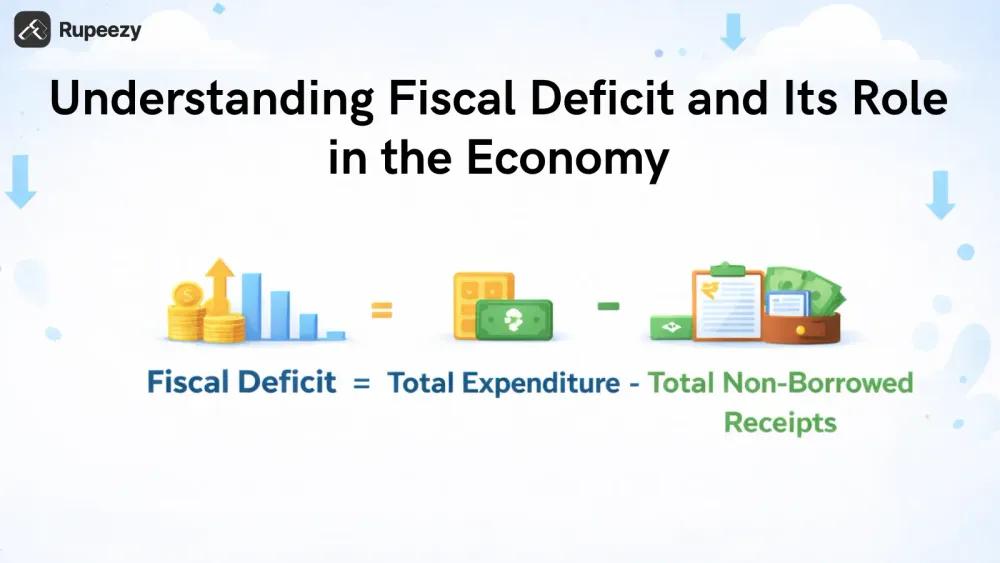
Fiscal Deficit = Total Expenditure - Total Non-Borrowed Receipts
Now, if spending is higher, the difference becomes the fiscal deficit. But if this is positive, then this is a fiscal surplus.
2. What Is Included in Total Expenditure
Now that you know the formula, let us find the expenditure. The aspects that are included are as follows:
Revenue expenditure such as salaries, subsidies, interest payments, and pensions.
Capital expenditure, such as infrastructure projects, defence equipment, and asset creation.
3. What Are Non-Borrowed Receipts
Non-borrowed receipts include:
Tax revenue, such as income tax, GST, and corporate tax.
Non-tax revenue, such as dividends from public sector companies and fees.
4. Why Borrowings Are Excluded
Borrowings are not treated as revenue because they create future repayment obligations. The formula focuses only on actual earnings to show the real budget gap.
Understanding the fiscal deficit formula helps greatly. But at the same time, you must know the features and impact as well.
Key Features of Fiscal Deficit
Fiscal deficit reflects the government’s financial position in a given year. It is not just a number in the budget. But it is a value that shows how your economy performs and works. Understanding its features helps in analysing how sustainable a country’s finances are.
1. Indicates the Government’s Borrowing Requirement
The fiscal deficit directly shows how much the government needs to borrow. This is mainly to meet its expenses when revenue falls short. The higher the deficit, the greater the reliance on market borrowings.
2. Calculated for a Specific Financial Year
It is measured annually as part of the Union Budget. This makes it a short-term indicator of fiscal performance. This is just for one financial year only.
3. Expressed as a Percentage of GDP
Instead of looking at the absolute number alone, the fiscal deficit is commonly shown as a percentage of GDP. This helps compare the deficit size as per the economy.
4. Includes Revenue and Capital Expenditure
The calculation considers both routine expenses, such as salaries and subsidies, and long-term investments such as infrastructure projects.
5. Reflects Overall Fiscal Discipline
A controlled fiscal deficit suggests good and effective financial management. But a consistently high deficit may raise concerns. It can be about rising debt and economic stability.

Importance of Fiscal Deficit
Now you know what the fiscal deficit is and its formula. This is key to better planning and policy design. Some of the key points to know are:
1. Supports Development Spending
If this is in the proper range, it is a good sign of government planning. This can be in infrastructure, healthcare, education, and social welfare programs. This spending strengthens long-term economic foundations.
2. Acts as a Policy Tool
Fiscal deficit helps the government stimulate the economy during slowdowns. This can help with the demand recovery during downfalls as well.
3. Reflects Fiscal Discipline
The level of fiscal deficit indicates the management of finances by the government. A moderate deficit suggests stability, while a rising one may signal financial imbalance.
4. Guides Budget Planning
It helps policymakers decide taxation, expenses, and borrowing. This is all you need for a better-running government.
Impact of Fiscal Deficit on the Economy and People
While fiscal deficit can drive growth, it has negative impacts too. It can be inflation or even higher costs. The key impacts are as follows:
1. Effect on Inflation
If government spending increases without the revenue, it can be a bad situation. It can raise the money supply and push prices higher. This directly affects consumers.
2. Influence on Interest Rates
Heavy government borrowing may increase interest rates. This can make the loans expensive, and everything can be highly expensive.
3. Impact on Public Debt
Continuous high fiscal deficits increase national debt. Higher debt leads to larger interest payments. This impacts the overall funds as well.
4. Effect on Investment Climate
Investors prefer economies with stable fiscal management. So, if the fiscal deficit is managed, policies are more streamlined.
Fiscal Deficit of India: Latest Numbers and Outlook
India’s fiscal deficit reflects the gap between the central government’s total expenditure and its total non-borrowed receipts. It is closely tracked. For better understanding, here is a quick view of the last few years.
1. Fiscal Deficit for FY2024–25
It is estimated at around 4.8% of GDP. This was down from approximately 5.9% in the previous year. This indicates a continued effort toward consolidation. And all this is attained while maintaining public investment. (Source)
2. Target for FY2025–26
In the Union Budget, the government has set a fiscal deficit target of 4.4% of GDP for FY2025–26. This is part of a structured glide path. This is aimed at bringing the deficit below 4.5% in the coming years. (Source)
3. Projection for FY2026–27
The projected fiscal deficit for FY2026–27 stands at 4.3% of GDP. This is defined by the commitment toward medium-term fiscal discipline. (Source)
4. Current Year Progress FY2025–26
During April to December FY2025–26, the fiscal deficit stood at approximately ?8.55–8.56 trillion. This is about 54.5% of the full-year budgeted estimate. (Source)
These numbers show a gradual and structured approach toward deficit reduction. But there is still room for growth in public development.
Conclusion
Fiscal deficit is more than a budget term. It reflects how responsibly a government manages spending, revenue, and borrowing. When the fiscal deficit is managed and controlled, it is good for the economy.
At the same time, investors can understand the economy using this. It can help with analysis. This is where you can use platforms like Rupeezy for further insights. Get all the details you need and ensure investing with accuracy.
FAQs
What is fiscal deficit in simple words?
Fiscal deficit is the difference between the government’s total expenditure and its total revenue excluding borrowings. It shows how much the government needs to borrow in a financial year.
What is the fiscal deficit formula?
The formula is: Fiscal Deficit = Total Expenditure - Total Non-Borrowed Receipts. It shows the gap and how borrowings are used to manage this.
Is a high fiscal deficit always bad?
Not necessarily. A moderate deficit can support economic growth during slowdowns. But this is only when public debt and inflation risks are controlled.
Why is fiscal deficit expressed as a percentage of GDP?
Expressing fiscal deficit as a percentage of GDP helps compare the deficit with the size of the economy. This helps to analyse borrowing levels well.
How does the fiscal deficit affect common people?
A higher fiscal deficit can increase inflation and interest rates. It can increase the cost of essentials. It can affect the household budgets, savings, and overall financial stability. It can also increase the cost of loans.
The content on this blog is for educational purposes only and should not be considered investment advice. While we strive for accuracy, some information may contain errors or delays in updates.
Mentions of stocks or investment products are solely for informational purposes and do not constitute recommendations. Investors should conduct their own research before making any decisions.
Investing in financial markets are subject to market risks, and past performance does not guarantee future results. It is advisable to consult a qualified financial professional, review official documents, and verify information independently before making investment decisions.







All Category