
Open a Free Demat Account !
₹0 AMC & Account Opening Fee
Dark Pool Trading Algorithms Explained Simply

 Last Updated: 04 September, 2026
 8 min read




00:00 / 00:00


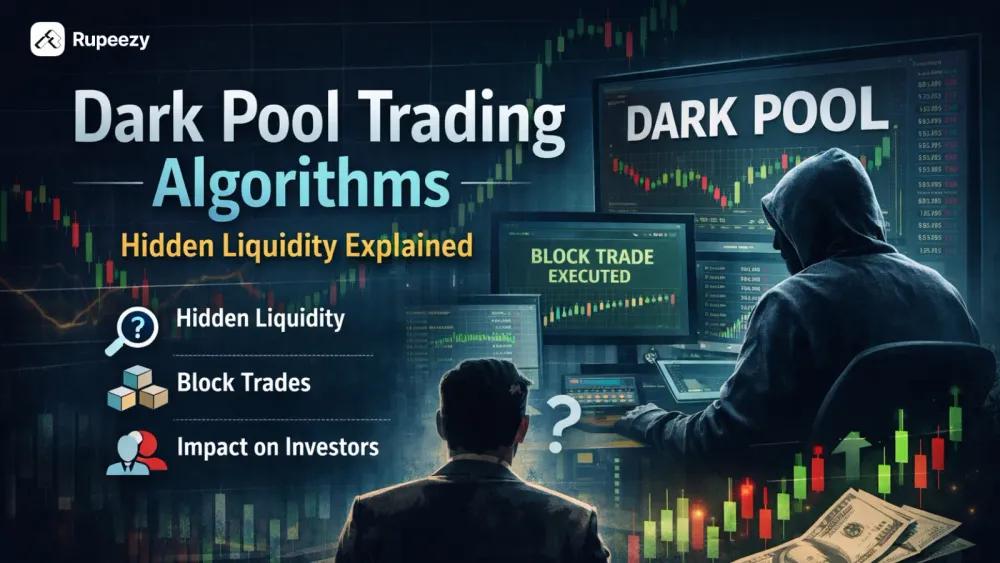
You may have often noticed that a stock suddenly starts moving rapidly without any major news. It becomes difficult for retail investors to understand why this is happening. One major reason for this could be dark pool trading. Dark pools are private trading platforms where large institutional investors execute their large trades discreetly, so as not to impact the market price immediately. In this blog, we will explain in simple and clear language how dark pool trading works and what its impact is on the market.
What Are Dark Pools?
Dark pools are private trading platforms where large institutional investors such as mutual funds, banks, and FIIs (Foreign Institutional Investors) buy and sell shares among themselves. The buy or sell information provided here is not visible in the public order book, meaning ordinary investors cannot see it on the NSE or BSE screens. The purpose is to execute large trades without causing significant market disruption.
What Dark Pools Are Not?
There are several misconceptions about dark pools that need clarification:
Dark pools are not illegal; they are regulated.
Not every dark pool trade constitutes market manipulation.
Most retail investors do not have direct access to them.
Main Types of Dark Pools
Currently, there are primarily three types of dark pools:
Broker-dealer operated dark pools
Stock exchange-affiliated dark pools
Independent institutional networks designed for large players
Why the Need for Dark Pools?
When a large investor buys or sells a large quantity of shares in the open market, the price tends to change rapidly. This is known as market impact. Additionally, displaying orders in the open market carries the risk of information leakage. Dark pools help mitigate both of these problems.
Why Do Institutions Avoid the Open Market?
Dark pool trading algorithms are specialized software systems designed to execute large orders without displaying them on public order books. These algorithms control the size, timing, and price of trades to avoid signaling the market and causing sudden price fluctuations. Today, these algorithms operate based on real-time data and predefined rules.
Difference between Lit Market and Dark Pool Algorithms :
Lit market execution algorithms operate on open exchanges where the order book is publicly visible, and prices can change rapidly. In contrast, dark pool algorithms operate on private platforms where order information is concealed. Therefore, dark pool algorithms prioritize discretion and stable execution over speed.
The Real Purpose of These Algorithms :
The primary objective of dark pool trading algorithms is to find hidden liquidity at the right time, execute trades at favorable prices, and minimize their footprint across different trading platforms. This helps large investors avoid unnecessary costs and market impact.
Integration with Lit Markets :
It's important to understand that dark pool trading algorithms do not replace open markets. They work in conjunction with lit markets, splitting orders between both venues when necessary. This balance contributes to the efficiency and liquidity of today's modern markets.
The actual workings of hidden liquidity
Order Matching within Dark Pools :
Hidden liquidity means that buy and sell orders are executed without being displayed in the public order book. Within dark pools, algorithms match orders with similar prices and quantities, allowing the trade to be completed directly between the buyer and seller without impacting the open market.
Phased Execution of Large Orders :
Large orders from institutional investors are typically not executed all at once. Dark pool algorithms break them down into smaller parts and execute them at different times. This process prevents sudden spikes in volume and helps maintain price stability.
Use of Midpoint Pricing :
In dark pool trading, transactions often occur at a price between the bid and ask prices. This provides better pricing for both parties and reduces the cost of the spread. This is one reason why large investors prefer dark pools.
Trade Reporting and Market Impact :
Trades executed in dark pools are reported later, in accordance with regulatory requirements. Although these trades are not immediately visible, their impact becomes evident over time in price and volume data.

Common Dark Pool Trading Algorithms
VWAP-Based Dark Pool Algorithms :
The primary objective of this algorithm is to execute trades at or near the market's average volume-weighted price (VWAP). Using a dark pool allows large orders to be filled in smaller increments, preventing sudden spikes in volume on the open market and avoiding undue pressure on prices.
Iceberg and Reserve Logic :
In this type of algorithm, the entire order is not displayed at once. Only a small portion is active for trading, while the rest of the quantity remains hidden. This prevents the market from receiving a signal that a large order is present, thus maintaining price stability.
Opportunistic Liquidity Seekers :
These algorithms constantly scan for available liquidity across various dark pools. As soon as an opportunity arises to execute a trade at a better price, the algorithm immediately acts on it. Its focus is solely on executing trades when there is a genuine price advantage.
Smart Order Routing and Dark Pools :
Smart order routing algorithms consider both lit exchanges and dark pools simultaneously. This algorithm quickly determines which part of the order should be routed for optimal execution. This leads to efficient execution and lower overall trading costs.
Dark Pool Trading vs High-Frequency Trading
Basis of comparison | Dark pool trading | High-frequency trading (HFT) |
Main objective | Executing large orders without impacting the market. | Making small profits very quickly. |
Transparency | The order and price are not visible to the public. | The orders are visible in the open market. |
Main focus | Confidentiality and minimal market impact | Speed, latency, and arbitrage |
Trading speed | Relatively slow and controlled | Orders can be placed and cancelled in microseconds. |
Order size | Mostly large institutional orders | Typically, very small orders. |
Impact on the market | The effect is gradual and indirect. | The effect is immediate and short-term. |
HFT's access to dark pools | With limited and strict rules | Not all dark pools offer direct access. |
Is Dark Pool Trading Fair for Retail Investors?
Retail traders cannot directly track dark pool trading because these trades do not appear in the public order book. However, some indicators can indirectly suggest the presence of hidden liquidity. These include sudden large block trades, sharp spikes in volume without any corresponding news, or a mismatch between price increases and delivery/volume figures. While these indicators suggest that some activity might be happening behind the scenes, they do not provide definitive confirmation.
Retail investors can also check today’s market movement to compare unusual price and volume activity with broader Nifty, Sensex, and sector trends.
Retail investors can complement volume and price analysis with a stock market heatmap to get a quick view of broader stock and sector performance. This can help put unusual price or volume movements into the context of wider market trends.
Risks and criticisms of dark pool trading
Lack of Transparency :
In dark pool trading, orders and prices are not visible in the public order book. This prevents a complete picture of overall market activity from emerging and reduces transparency, which is a concern for retail investors.
Impact on Price Discovery :
Because large trades occur outside the open market, in some cases, the true supply and demand for a stock may not be accurately reflected promptly. This can slow down or distort the price discovery process.
Conflicts of Interest in Broker-Owned Dark Pools :
When a broker operates its own dark pool, a conflict of interest arises. The question then becomes whether the broker is prioritizing the client's best interest or the volume on its own platform.
Challenges for Regulatory Oversight :
Monitoring dark pools is more complex for regulators because trades are not publicly disclosed in real time. This is why regulations are periodically tightened to prevent abuse.
Why is it still permitted?
Despite these risks, regulators permit dark pool trading because it provides deeper market liquidity and allows large institutional investors to execute their trades more efficiently.
Conclusion
Dark pool trading is the invisible part of the stock market, but its presence is definitely felt. It's not part of a conspiracy, but rather a method for large investors to achieve better and lower-cost execution. Retail investors must understand it instead of fearing it, and view price and volume behavior in the proper context. Only when you understand both the visible and invisible activities of the market will your trading and investment decisions become more balanced and informed.
FAQs
Q1. What does dark pool trading mean?
In dark pool trading, large investors execute their large trades on private platforms to avoid sudden price fluctuations in the market.
Q2. Can a retail investor use dark pool trading?
Generally, no. Dark pools are primarily for institutional investors.
Q3. Is dark pool trading legal in the stock market?
Yes, it is completely legal and operates under regulatory guidelines.
Q4. Does dark pool trading impact share prices?
Yes, but the impact is gradual and indirect.
Q5. Can retail traders identify dark pool activity?
Not directly, but some indicators, like sudden volume spikes or block deals, can provide clues.

Anupam Shukla is a finance content writer and an NISM-certified research analyst with over Seven years of trading experience. With a passion for the stock market, he simplifies complex financial concepts, making investing and trading easier for everyone. His expertise helps readers stay ahead in the ever-changing world of finance, empowering them to make smarter money moves.
Did you like this blog?
Be the first to like this blog.
The content on this blog is for educational purposes only and should not be considered investment advice. While we strive for accuracy, some information may contain errors or delays in updates.
Mentions of stocks or investment products are solely for informational purposes and do not constitute recommendations. Investors should conduct their own research before making any decisions.
Investing in financial markets are subject to market risks, and past performance does not guarantee future results. It is advisable to consult a qualified financial professional, review official documents, and verify information independently before making investment decisions.


All Category