
Open a Free Demat Account !
₹0 AMC & Account Opening Fee
Algorithmic vs HFT Key Differences

 Last Updated: 04 September, 2026
 7 min read



00:00 / 00:00


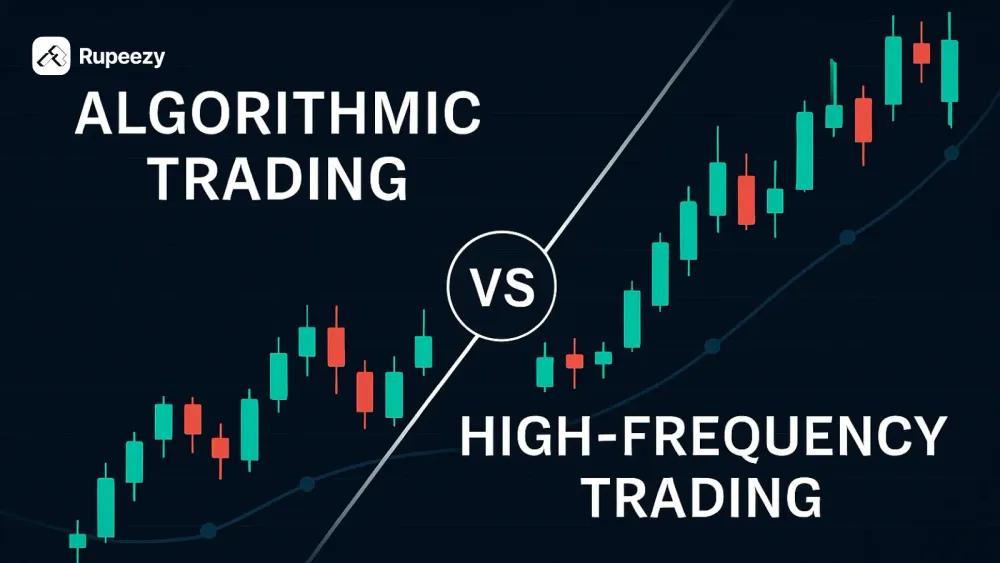
Trading has changed in India and globally over the past few years. According to 2025 data, approximately 57% of equity-cash trades and 70% of derivative trades in India are now conducted through algorithms, or auto-trading. This has made trading faster, transparent, and less emotional, but many people still confuse it with High-Frequency Trading (HFT). In this blog, we will explain, in simple terms, the real difference between "Algorithmic Trading" and HFT.
What Is Algorithmic Trading?
Algorithmic trading, or Algo Trading, is a system in which trading is conducted not by humans but by computer programs. These programs determine when to buy and sell based on pre-determined rules, data, and mathematical models. This makes trading fast, accurate, and emotion-free.
How does it work?
Algo Trading operates in three main phases:
Market Data Analysis: The system continuously reads market data such as price, volume, and trends.
Signal Generation: When the data matches a rule or pattern, the system generates a trade signal.
Auto Execution: Orders are placed automatically without any human intervention in milliseconds.
Popular Algo Strategies
Some common strategies used by Algo Traders are:
Trend Following: Buying when the price is rising and selling when it is falling.
VWAP/TWAP Execution: Executing a large order in small batches to minimize the impact on the price.
Arbitrage: Taking advantage of price differences in two markets.
Mean Reversion: Believing that the price always returns to its average and trading accordingly.
Who uses it?
Algo Trading was previously limited to:
Hedge Funds
Investment Banks
Institutional Brokers
What is High-Frequency Trading (HFT)?
High-Frequency Trading (HFT) is a trading technique that uses high-speed computer systems, ultra-low latency networks, and extremely fast algorithms to execute market trades within milliseconds or microseconds. Trading speed is the driving force here; the faster the response, the greater the profit.
How does it work?
The trading process in HFT operates at near-lightning speed:
Real-Time Market Scanning: The system scans millions of data points every second.
Ultra-Fast Decision Making: The system makes decisions instantly upon detecting pricing gaps, arbitrage opportunities, or micro-trends.
Instant Execution: Trades are executed in less than a second the faster the execution, the better.
The goal of HFT is not to generate large profits, but to profit by trading large volumes at very small margins.
Common HFT Strategies
Some key strategies are:
Market Making: Profiting from small spreads by providing buy and sell quotes at all times.
Statistical Arbitrage: Identifying small price differences and trading quickly.
Liquidity Detection: Identifying the presence of large orders in the market and trading on their execution patterns.
Latency Arbitrage: Taking advantage of price lag by executing faster than other traders.
Who practices HFT?
HFT is generally only for institutional-level traders because it requires:
High-speed servers
Exchange co-location access
Dedicated fiber-optic systems
Highly optimized algorithms
Algorithmic vs High-Frequency Trading: Key Differences
Comparison point | Algorithmic Trading (Algo Trading) | High-Frequency Trading (HFT) |
Purpose | Automating trading and removing human emotion. | Earn micro-profits in the market through speed advantage. |
Execution Speed | From seconds to minutes. | At the micro-second or nano-second level. |
Holding Duration | Positions may be held for minutes, hours or weeks. | Trades are entered and exited almost instantly. |
Capital Requirement | Medium to High Retail traders can also do it. | Very high mainly at the institutional level. |
Technology Setup | Normal VPS, API, Cloud Server is enough. | Co-location servers, ultra-low latency network and infrastructure required. |
Who Uses It? | Retail traders, brokers, asset managers, hedge funds. | Market makers, prop firms, global hedge funds. |
Strategy Style | Trend following, mean reversion, VWAP/TWAP, arbitrage. | Market making, latency arbitrage, quote stuffing, scalping. |
Order Frequency | Low to medium order volume. | Very high thousands or millions of orders per day. |
Risk Nature | Strategy dependent but relatively controlled. | Very high because there is a huge dependency on micro-margins. |
Regulatory Impact | Regulations exist but are flexible. | More strict monitoring and compliance is required. |
Profit Style | The profit per trade can be large or moderate. | Very small profit per trade, but very high volume. |
Learning Curve | A mix of coding + market psychology. | Advanced quant, math, network latency and infrastructure knowledge required. |
When to Use Algorithmic Trading
When You Need to Balance Your Portfolio
If you invest long-term and want your portfolio to be periodically rebalanced (such as maintaining an equity-debt ratio), Algo Trading can seamlessly perform this task without manual intervention.
When You Prefer Systematic Investing
Algo Trading is ideal when you want to trade consistently with predefined rules, backtested logic, and disciplined execution whether the market is calm or volatile.
Traders can also check today’s market movement to understand current Nifty, Sensex, and sector conditions before applying an automated strategy to the market.
When You Want Emotion-Free Trading
Human emotions like fear, greed, and overconfidence can distort trading decisions. Algo Trading eliminates these psychological biases and bases decisions solely on data and logic.
Scalability is required
Let's say you're running a strategy with ?50,000 today if the same strategy is verified and working, the same algo can be run for millions or even crores without increasing workload. This scalability isn't possible in human trading.
When you want to save time with automation
Algo trading is very useful for busy professionals, working traders, and those who don't have time to constantly watch charts. The program automatically monitors the market and executes at the right time.
When to use High-Frequency Trading (HFT)?
When Speed ??Is Your Competitive Advantage
High-Frequency Trading is useful when your entire trading strategy is based on execution speed. In HFT, even milliseconds matter, so it's ideal for traders or firms that can react faster than others in the market.
When You Have Advanced Low-Latency Infrastructure
HFT is only practical when you have co-location servers, high-speed connectivity, and ultra-fast execution systems. Without low-latency technology, HFT cannot be profitable because delays eliminate the edge.
When Your Trading Is Based on High Volume
HFT is ideal for strategies that profit from very small price movements but execute at high volume. Here, the profit per trade is small, but execution frequency makes it meaningful.
When You're Playing a Market-Making or Liquidity-Driven Role
HFT is particularly suitable for institutions that provide frequent buy and sell quotes. Such firms can generate stable and predictable returns through bid-ask spreads and rapid matching.
When You Have the Ability to Manage Regulatory Compliance
HFT is a heavily monitored category and requires transparency, reporting, and audit systems. This approach is only sustainable long-term if your team can effectively manage compliance while integrating technology.
Risks of Algorithmic Trading
Strategy Decay
Sometimes a trading strategy performs well initially, but over time, its effectiveness diminishes as the market changes. This is called strategy decay, and periodic testing and optimization are necessary to prevent it.
Risk of Overfitting
If a system is built perfectly only on historical data but is unable to adapt to real-time markets, the strategy may fail. This is called overfitting, that is, the system only looks good in the past but struggles in the future.
Poor Risk Management
Algo trading is automated, but without proper stop-loss, position sizing, and risk limits, automation can sometimes lead to significant losses.
Blind Trust on the System
Many traders treat the algorithm like a "black box" and rely on it without understanding it. However, a lack of manual supervision can exacerbate losses when the market changes.
Risks of High-Frequency Trading (HFT)
High Infrastructure Cost
Starting HFT requires high-speed servers, co-location access, and low-latency networks, which are very expensive. Therefore, it is practically unfeasible for retail users.
Latency Competition
Competition in HFT is intense. Simply having a fast system isn't enough—you must consistently outperform others in the market, or your strategy becomes ineffective.
Regulatory Oversight
HFT is often subject to strict regulations, as regulators want to ensure that systems don't engage in market manipulation, spoofing, or offer unfair advantages. Failure to comply can lead to heavy penalties or even a ban.
System Vulnerability
HFT is tech-driven, so if there's a bug, glitch, or connectivity failure in the system, trades can go in the wrong direction and losses can mount rapidly. Some global flash-crash events are examples of this.
Conclusion
Algo trading and high-frequency trading have both made markets faster, data-driven, and disciplined, but their purposes and uses are quite different. Algo trading is a structured and scalable approach for every type of trader and investor, while HFT is only for those entities with the advantage of speed, technology, and capital. The right choice depends on your goal stability and automation or ultra-fast execution and micro-profits.
FAQs
Q 1: What is the main difference between Algo Trading and HFT?
Algo Trading trades take place in seconds or minutes, while HFT trades take place in microseconds.
Q 2: Can retail traders use HFT?
No, HFT is generally only used by large institutions.
Q 3: Is Algorithmic Trading legal in India?
Yes, it is completely legal and regulated by SEBI.
Q 4: Is HFT risky?
Yes, because the impact of errors is greater due to its very fast execution and high volume.
Q 5: Which is better for beginners?
Algorithmic Trading is a better and easier option for beginners.
Anupam Shukla is a finance content writer and an NISM-certified research analyst with over Seven years of trading experience. With a passion for the stock market, he simplifies complex financial concepts, making investing and trading easier for everyone. His expertise helps readers stay ahead in the ever-changing world of finance, empowering them to make smarter money moves.
Did you like this blog?
Be the first to like this blog.
The content on this blog is for educational purposes only and should not be considered investment advice. While we strive for accuracy, some information may contain errors or delays in updates.
Mentions of stocks or investment products are solely for informational purposes and do not constitute recommendations. Investors should conduct their own research before making any decisions.
Investing in financial markets are subject to market risks, and past performance does not guarantee future results. It is advisable to consult a qualified financial professional, review official documents, and verify information independently before making investment decisions.


All Category