
Open a Free Demat Account !
₹0 AMC & Account Opening Fee
Execution Algos Explained: POV, IS & More

 Last Updated: 04 September, 2026
 8 min read




00:00 / 00:00


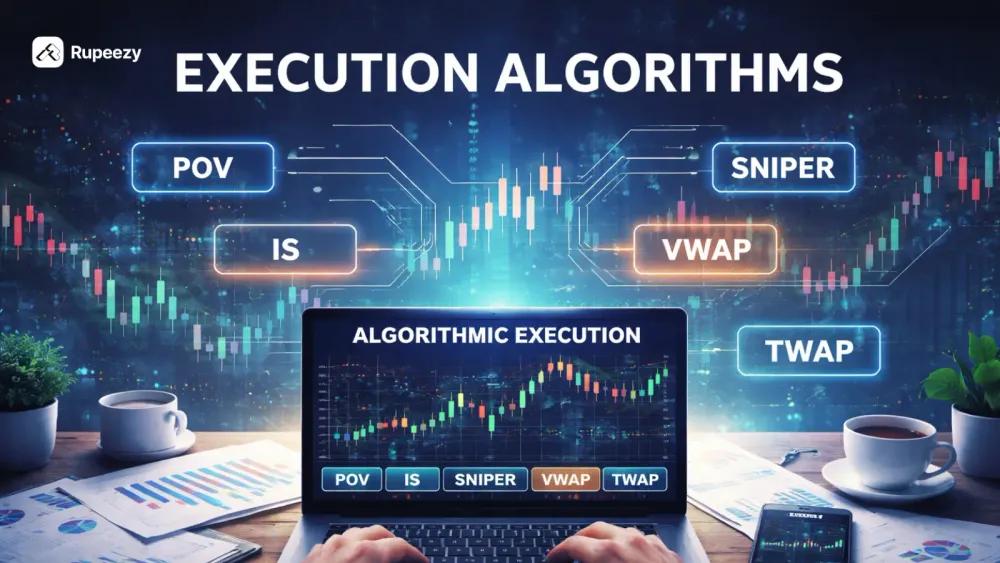
Often in trading, our entire focus is on which stock to buy or sell, but the real difference is made where the trade is executed. Sometimes, even with accurate analysis, poor execution leads to weak returns. Slippage, market impact, and incorrect timing gradually erode profits. This is why today's professional traders use execution algorithms. In this blog, we will understand in simple terms what execution models like POV, IS, and Sniper are and how to use them effectively in different market conditions.
What Are Execution Algos?
Execution algorithms are automated trading models that execute a large order in smaller increments (child orders) instead of placing the entire order at once. The goal is to avoid putting undue pressure on the market during trading and to achieve a better average price. The main objectives of these algorithms are to minimize market impact, control slippage, and make execution more efficient. When a large order is placed directly into the market, the price can move sharply up or down. Execution algorithms handle this problem intelligently. Today, execution algorithms are used not only by large institutions but also by proprietary trading desks, algo traders, and advanced retail traders. It's important to understand that execution algorithms do not predict market direction. They are not designed to generate alpha, but rather to execute your already decided trade in a more optimal way. Proper execution forms a strong foundation for good trading results.
The Real Costs Execution Algos Are Designed to Control
The main function of execution algorithms is not just to automate orders, but to minimize the hidden costs that silently erode trading performance. These costs are typically understood in four categories:
Explicit Costs :
These are the costs every trader is aware of such as brokerage, exchange charges, STT, GST, and other taxes. Execution algorithms have a direct impact on reducing these costs, but better execution can also prevent unnecessary trades.
Market Impact :
When a large order is placed in the market all at once, the price tends to move in the same direction. The larger the order, the greater the impact. Execution algorithms mitigate this pressure by breaking down orders into smaller parts.
Slippage :
In volatile or low-liquidity markets, slippage increases rapidly. Execution algorithms attempt to control this gap through smart timing and order placement.
Opportunity Cost :
Executing too slowly can cause you to miss out on profitable moves. This cost is often the most damaging, especially in fast-moving markets.
POV (Participation of Volume): Trading With the Market
What is POV?
POV, or Participation of Volume, is an execution algorithm where your order is executed as a fixed percentage of the total volume traded in the market.
For example, if you set POV to 10%, the algorithm will attempt to execute approximately 10 shares for every 100 shares traded in the market. This allows your order to flow naturally with the market.
How does POV actually work?
The POV algorithm continuously monitors market activity.
When market volume increases, it increases the execution speed.
When volume decreases, it automatically slows down.
This is why this algorithm is considered liquidity-aware and is less noticeable in the market.
Best Use Cases for POV
The POV algorithm works particularly well when:
You are trading highly liquid stocks or index futures.
You don't want to signal to the market that you are an urgent buyer or seller.
You have sufficient time for execution.
Risks and Limitations
The biggest limitation of the POV algorithm is that it can lag behind during rapid price movements. If the market suddenly experiences a sharp rise or fall, the execution may take longer to complete. This is why it is not considered ideal for urgent or event-driven trades.

IS (Implementation Shortfall): The Institutional Benchmark
What is Implementation Shortfall?
Implementation Shortfall is an execution model that measures the total cost incurred between the price at which you decided to trade and the price at which the trade was actually executed. This includes not only the price difference but also the costs of slippage, market impact, and execution delays. The goal of this model is to execute trades neither too quickly nor too slowly, but to maintain a balance based on current market conditions.
Why do Institutions prefer the IS Algo?
Institutions prefer the IS algo because it doesn't operate on a fixed schedule, but is goal-based. It continuously observes market conditions and adjusts the execution speed accordingly. If the market starts moving against you, it speeds up execution, and if the market is favorable, it exercises a little patience. Its focus is not just on the lowest price, but on overall execution efficiency.
How does the IS Algo work?
The IS algo attempts to understand market movements in real-time. When the price moves in an unfavorable direction, it becomes more aggressive to prevent the opportunity cost from increasing. Conversely, when the market is calm or favorable, it slows down execution to achieve a better average price. In this way, it strikes a practical balance between price and timing.
When is the IS Algo most useful?
This execution model is particularly useful for large orders, event-driven trades such as those related to news or earnings, and in situations where delaying the trade could be detrimental. In such cases, the IS algo helps control the total execution cost, rather than simply chasing an ideal price.
Sniper / Liquidity-Seeking Algos: Precision Over Patience
What is a Sniper Algo?
A Sniper or Liquidity-Seeking Algo is an execution model that actively searches for hidden or sudden liquidity in the market. Its goal is not to execute gradually, but to act quickly at the right moment. When a large quantity or block of liquidity suddenly appears in the order book, this algo executes immediately to take full advantage of that liquidity.
How does a Sniper Algo work?
This algo remains mostly passive in the market and continuously observes the order book. As soon as it finds favorable liquidity or a price level, it executes aggressively without delay. It typically uses order types like IOC (Immediate-Or-Cancel) or FOK (Fill-Or-Kill) to avoid partial fills or unnecessary exposure.
When does a Sniper Algo work best?
Sniper algos are most effective in situations where sudden block orders appear in the market, or an order book imbalance occurs. Their performance is generally better in high-liquidity instruments, fast-moving markets, and low-latency trading environments.
Risks associated with Sniper Algos
If a Sniper algo is not configured correctly, it can become overly aggressive and execute at unfavorable prices. Using it in low-liquidity stocks can increase risk, so strong risk controls and a thorough understanding of the market are crucial.
VWAP and TWAP
TWAP (Time-Weighted Average Price)
TWAP is a simple execution model where an order is executed in equal parts over a predetermined time period. This algorithm is predictable and works well when the market is stable. However, during periods of high volatility or sudden price movements, TWAP can lag behind, as it doesn't adjust to live market conditions.
VWAP (Volume-Weighted Average Price)
The VWAP algorithm follows historical market volume patterns and executes orders accordingly. It is often used as a benchmark. However, it also doesn't fully reflect live market changes, especially on event-driven days or days with unusual volume.
While VWAP and TWAP seem safe, they are not suitable for every situation. Using them without considering the market context can sometimes lead to increased slippage.
Traders can also check today’s market movement to understand current Nifty, Sensex, and sector trends before choosing an execution approach based on volatility, liquidity, and urgency.
How to choose the right execution algorithm?
The choice of execution algorithm can vary from trade to trade. Making the right decision requires understanding the specific trade situation, not just looking at the algorithm's name. If the trade is very urgent and the price is moving rapidly, a slow execution could be detrimental. Conversely, if the stock is highly liquid and there's no particular time pressure, following the market is often the better approach.
The nature of the market also plays a crucial role. Trending markets present higher opportunity costs, while range-bound markets reward patience. Furthermore, it's essential to understand whether the volume is stable or suddenly increasing due to a specific event.
Before selecting an execution algorithm, traders can also review broader market and sector movements to understand where activity and momentum are concentrated. A market heatmap can provide a quick visual overview of stock and sector performance, helping traders assess the market context before executing large orders.
Scenario | Suggested Algo |
High urgency trade | IS / Sniper |
High liquidity, low urgency | POV |
Benchmark-focused execution | VWAP |
Simple and predictable execution | TWAP |
Conclusion
Choosing the right stock is crucial in trading, but executing the trade correctly is equally important. Execution algorithms such as POV, IS, Sniper, VWAP, and TWAP help traders avoid hidden costs like slippage, market impact, and poor timing. Each algorithm has its own role and limitations, so instead of using them blindly, they should be chosen based on market conditions and the urgency of the trade. Only when execution is also made a part of the strategy can trading decisions truly yield better results.
FAQs
Q1. What are execution algorithms?
Execution algorithms help control trading costs by intelligently executing large orders in smaller increments.
Q2. Are execution algorithms only for large institutions?
No, many advanced retail traders also use execution algorithms today.
Q3. Which execution algorithm works best for urgent trades?
IS (Implementation Shortfall) or Sniper algorithms are considered more effective for urgent trades.
Q4. Is VWAP always the safest option?
No, VWAP can increase risk in volatile or event-driven markets.
Q5. Do execution algorithms predict price movement?
No, execution algorithms only optimize order execution, not predict price direction.

Anupam Shukla is a finance content writer and an NISM-certified research analyst with over Seven years of trading experience. With a passion for the stock market, he simplifies complex financial concepts, making investing and trading easier for everyone. His expertise helps readers stay ahead in the ever-changing world of finance, empowering them to make smarter money moves.
Did you like this blog?
Be the first to like this blog.
The content on this blog is for educational purposes only and should not be considered investment advice. While we strive for accuracy, some information may contain errors or delays in updates.
Mentions of stocks or investment products are solely for informational purposes and do not constitute recommendations. Investors should conduct their own research before making any decisions.
Investing in financial markets are subject to market risks, and past performance does not guarantee future results. It is advisable to consult a qualified financial professional, review official documents, and verify information independently before making investment decisions.


All Category