
Open a Free Demat Account !
₹0 AMC & Account Opening Fee
Arbitrage Trading in India: Is It Legal?

 Last Updated: 26 August, 2026
 9 min read




00:00 / 00:00


In the Indian stock market, a single stock often trades at different prices simultaneously across different exchanges or segments. This is where arbitrage trading comes into play. However, new investors often mistake it for illegal trading or market manipulation. In this blog, we will explain in simple terms whether arbitrage trading is legal in India, how retail traders practically execute it, and what SEBI permits and what mistakes to avoid. This guide is for traders, investors, and those learning about finance.

What Is Arbitrage Trading?
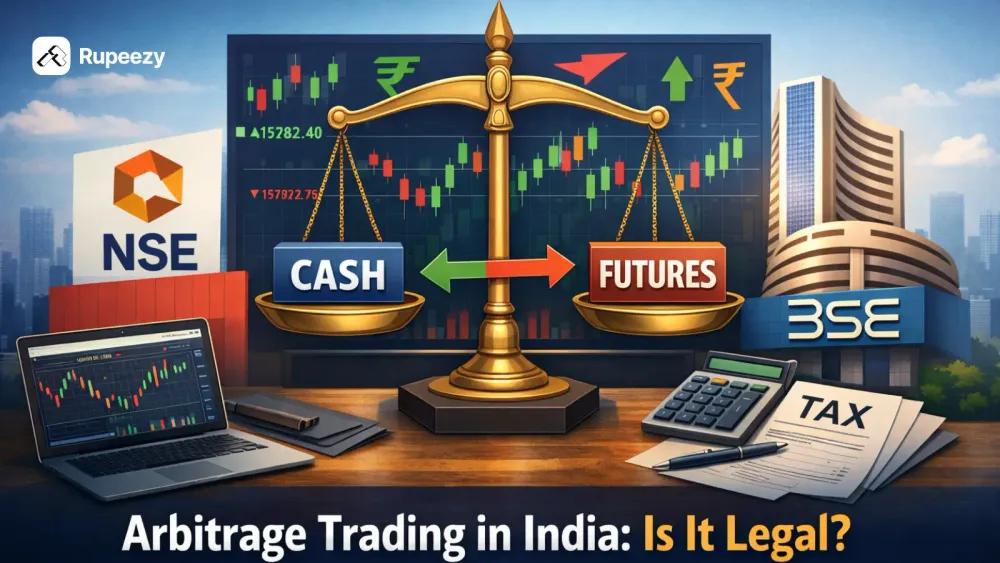
Arbitrage trading means profiting from price differences of the same asset (such as a stock) in different markets or segments with minimal risk. For example, if a stock is trading at a slightly lower price in the cash market and at a higher price in the futures market at the same time, a trader can buy in the cash market and sell in the futures market. This entire process is conducted within regulatory guidelines.
Why do price differences occur in the Indian market?
Price differences are common in a large and rapidly evolving market like India. The main reasons for this are:
Differences in Liquidity: The number of buyers and sellers is not the same for every stock or segment.
Changes in Demand and Supply: Sudden news, results, or changes in market sentiment can cause prices to react at different speeds.
Timing Gap: The speed of order execution can differ between the cash and derivatives segments.
Is Arbitrage Trading Legal in India?
Arbitrage trading is completely legal in India, provided it is conducted within all the rules and regulations. The Indian stock market regulator, SEBI, does not consider arbitrage illegal because it helps increase market efficiency and reduce price discrepancies. This is why institutional investors, mutual funds, and professional traders openly engage in it.
Why does SEBI allow Arbitrage Trading?
From SEBI's perspective, arbitrage trading is not harmful to the market, but rather beneficial.
It quickly corrects mispricing gaps.
It maintains a balance between the cash and derivatives segments.
It increases liquidity and reduces extreme volatility.
Therefore, as long as the trading is genuine and rule-based, arbitrage is considered a legitimate activity.
An Important Note: What Arbitrage is NOT
People often misunderstand arbitrage, so this clarification is necessary:
Arbitrage ? Insider Trading: If a person uses unpublished price-sensitive information (UPSI), it will be considered insider trading, not arbitrage.
Arbitrage ? Market Manipulation: Creating artificial volume, placing fake orders, or deliberately influencing prices is illegal, even if it is labeled as arbitrage.
When can Arbitrage Trading be Illegal?
Arbitrage is considered illegal when the trader violates the rules, such as:
Using UPSI (trading on confidential information like company results or mergers)
Creating artificial volume or misleading trades
Not complying with exchange settlement or delivery rules
Creating suspicious patterns in algorithmic trading without permission or disclosure
Types of Arbitrage Trading Used in India
Cash–Futures Arbitrage :
This is the most widely used method of arbitrage trading in India. In this method, a trader buys shares in the cash market and simultaneously sells the same shares in the futures market. The profit comes from the price difference between the cash and futures markets. This opportunity typically arises around expiry dates, in volatile markets, or when the futures premium is high. This is considered the most practical arbitrage for retail traders, provided the costs and margins are properly understood.
Inter-Exchange Arbitrage (NSE vs BSE) :
In this type of arbitrage, the same share is bought at a lower price on one exchange and sold at a higher price on another exchange. While this sounds simple, execution speed, settlement rules, and delivery obligations become crucial. A slight delay or settlement error can turn the entire arbitrage into a loss, so this method demands experience and robust systems.
Statistical / Pair Arbitrage :
This is an advanced arbitrage strategy that involves the statistical analysis of the price behavior of two correlated stocks (such as companies in the same sector or group). This strategy is mostly used by institutions, hedge funds, and professional algo traders. It carries a higher risk for retail traders as it requires fast execution, robust data, and regulatory compliance.
Arbitrage through Arbitrage Mutual Funds :
For investors who do not want to trade themselves, arbitrage mutual funds are the easiest and safest option. These funds internally employ strategies like cash-futures arbitrage, and the Asset Management Company (AMC) handles all the trading, execution, and compliance. This is why this method is considered most suitable for non-traders and conservative investors.

SEBI Rules & Regulatory Framework Around Arbitrage Trading
SEBI's focus is on ensuring that arbitrage is genuine trading and not a form of manipulation or unfair practice.
Exchange-Level Rules: What traders need to follow
When performing arbitrage, simply spotting an opportunity is not enough; adherence to exchange rules is paramount.
Settlement Obligations: Every trade must be settled according to the prescribed settlement cycle. If it's delivery-based arbitrage, the shares must be delivered or received on time. Failure to settle can result in penalties or restrictions.
Delivery vs. Non-Delivery Positions: In cash-futures arbitrage, the cash leg is typically delivery-based, while the futures leg is non-delivery. Traders must clearly understand which trade will result in delivery and which will be squared off.
Algo Trading Regulations and Their Role in Arbitrage :
Today, many arbitrage opportunities are executed through algorithmic trading. SEBI and the exchanges have implemented strict regulations for algorithmic trading, such as:
Registration of the algorithm with the broker/exchange
Proper risk controls and audit trails
Strict monitoring of suspicious patterns (such as spoofing or layering)
These regulations aim to ensure that no trader manipulates the market under the guise of arbitrage.
Recent Changes: Faster Settlement and Stricter Surveillance
In recent years, SEBI has promoted faster settlement cycles (such as T+1 and optional T+0 for select stocks). This has shortened the time window for arbitrage opportunities, making execution discipline even more crucial. Simultaneously, exchanges have strengthened real-time surveillance systems, which immediately flag repetitive or unusual arbitrage patterns.
How Retail Traders Can Do Arbitrage Trading
Step 1: Choose the Right Arbitrage Type
For retail traders, cash-futures arbitrage is considered the most practical, as the process is straightforward and opportunities are more frequent. If you don't want to trade yourself or don't have the time, arbitrage mutual funds are a better option than direct trading.
Step 2: Choosing the Right Broker and Platform
In arbitrage trading, fast execution, a stable platform, and a clear margin system are of utmost importance. For example, Rupeezy platforms offer retail traders a user-friendly interface, quick order execution, and transparent charges, which are essential for low-margin strategies like arbitrage.
Step 3: Don't take Cost Calculation lightly
Brokerage, STT, exchange charges, GST, and stamp duty all of these can significantly reduce arbitrage profits. Therefore, always calculate the net profit before placing a trade.
Step 4: Maintain Execution Discipline
In arbitrage trading, most traders use limit orders to maintain control over the price. Avoiding partial fills and slippage is crucial; otherwise, even a low-risk trade can result in a loss.
Step 5: Risk Control and Record Keeping
Maintain proper records of every trade contract, notes, margin details, and trade logs. Accurate documentation not only helps with analysis but also protects you during any audit or inquiry.
Before identifying an arbitrage opportunity, traders can use a stock market heatmap to compare stock and sector performance and quickly spot stocks showing notable price movements or market activity. This can help narrow down potential stocks for further arbitrage analysis.
Taxation of Arbitrage Trading in India
Arbitrage Mutual Funds vs Direct Arbitrage Trading – Tax Comparison
Aspect | Arbitrage Mutual Funds | Direct Arbitrage Trading |
Tax Category | Equity-Oriented Mutual Fund | Business Income |
Short-Term Holding | 15% STCG for periods less than 12 months. | Tax according to the slab rate |
Long-Term Holding | For periods longer than 12 months, gains up to Rs. 1.25 lakh are tax-free, after which a 10% LTCG (Long-Term Capital Gains) tax applies. | Not applicable |
Indexation Benefit | No | No |
Tax Complexity | Less and simpler | More and technical |
Audit Risk | Next to nothing | A higher turnover increases the risk of an audit. |
Compliance Effort | Very little | More (books, turnover, returns) |
Suitable For | Investors / conservative profiles | Active & frequent traders |
Real Risks in Arbitrage Trading
Execution Risk :
The profit in arbitrage is very small. If both the buy and sell legs are not executed simultaneously at the correct price, the expected profit can instantly turn into a loss. This risk increases significantly during rapid market movements.
Sudden Loss of Liquidity :
Sometimes, the liquidity disappears at the very moment the price difference for arbitrage appears. This means you can't find a buyer or seller, and the trade remains incomplete.
Changes in Margin Requirements near Expiry :
Exchanges increase margin requirements near futures expiry. If the extra margin is not deposited on time, the broker may square off the position, resulting in a loss.
Regulatory Scrutiny on Repetitive Trades :
Repeated arbitrage trades following the same pattern attract the attention of exchanges and regulators. If the trades appear unusual or misleading, clarification or restrictions may be imposed.
Overconfidence due to the perception of "Low-Risk" :
Arbitrage is considered low-risk, but not risk-free. Overconfidence can lead traders to increase their trade size, and a single incorrect execution can impact their entire capital.
Conclusion
Arbitrage trading is a legal and legitimate strategy in India, but it's not as simple as it seems. Profits are typically small, and success depends entirely on execution, discipline, and compliance. For new investors, arbitrage mutual funds may be a safer option, while active traders must pay close attention to costs, taxes, and risk management. With the right understanding and adherence to regulations, arbitrage can become a stable investment opportunity.
FAQs
Q1. Is arbitrage trading legal in India?
Yes, arbitrage trading is legal in India, provided it is conducted within the framework of SEBI and exchange rules.
Q2. Can beginners try arbitrage trading?
For beginners, arbitrage mutual funds are a better and safer option than direct trading.
Q3. Is arbitrage completely risk-free?
No, the risk is low, but there is still a risk related to execution and liquidity.
Q4. How is arbitrage income taxed?
Arbitrage funds are subject to equity tax, while direct trading is considered business income.
Q5. Do I need a large amount of capital for arbitrage?
No, but with less capital, the profit will also be limited.

Anupam Shukla is a finance content writer and an NISM-certified research analyst with over Seven years of trading experience. With a passion for the stock market, he simplifies complex financial concepts, making investing and trading easier for everyone. His expertise helps readers stay ahead in the ever-changing world of finance, empowering them to make smarter money moves.
Did you like this blog?
Be the first to like this blog.
The content on this blog is for educational purposes only and should not be considered investment advice. While we strive for accuracy, some information may contain errors or delays in updates.
Mentions of stocks or investment products are solely for informational purposes and do not constitute recommendations. Investors should conduct their own research before making any decisions.
Investing in financial markets are subject to market risks, and past performance does not guarantee future results. It is advisable to consult a qualified financial professional, review official documents, and verify information independently before making investment decisions.





All Category