
What Is a Yield Curve & Why It Matters

 Last Updated: 24 March, 2026
 8 min read




00:00 / 00:00


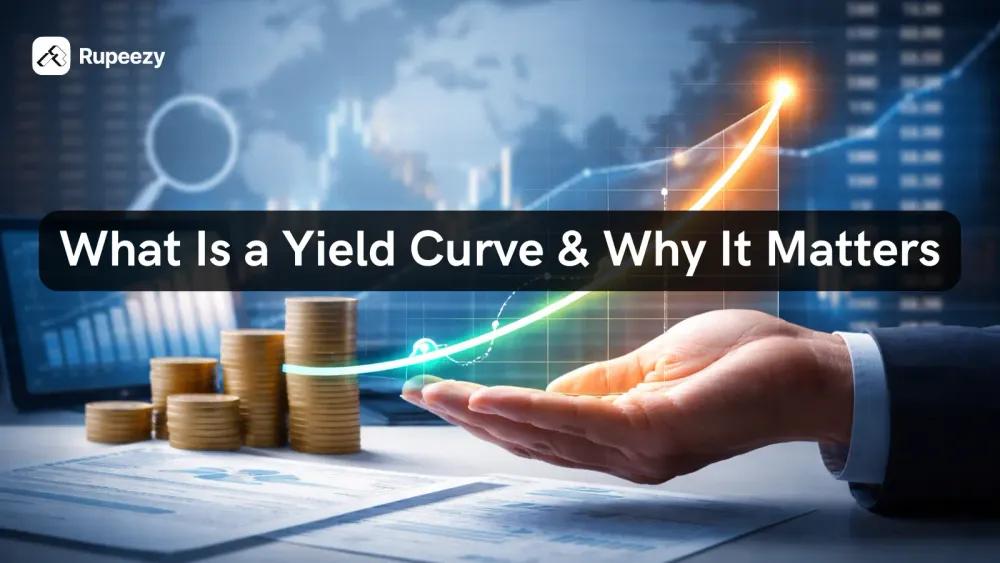
If you want to understand the direction the economy is headed, the yield curve provides a crucial indicator. In simple terms, the yield curve shows the interest rates offered on government bonds of different maturities. It's often referred to as the bond market's body language because it subtly signals future economic conditions. While the stock market fluctuates daily, the yield curve changes gradually, signaling significant shifts. In this blog, we'll not only define the yield curve but also understand how professionals interpret it and why it matters to investors, businesses, and jobs.

What Is a Yield Curve?
The yield curve is a professional financial tool that shows the return, or yield, that investors are receiving on government bonds of different maturities. It is typically represented as a graph, where the X-axis shows time (such as 3 months, 2 years, 10 years) and the Y-axis shows the interest rate. It's important to understand that the yield curve is directly related to government bonds, not stock market returns. People often mistakenly associate it with the stock market, which is a common misconception. The yield curve doesn't just show interest rates; it also reflects market sentiment and expectations. It provides insights into what investors anticipate regarding the future economy, inflation, and growth. Generally, longer-term bonds offer higher yields because they carry greater risk and uncertainty. This is why the yield curve is considered a reliable indicator of the economy.
Types of Yield Curves
A yield curve is not just a simple line graph; its shape reveals how the market and investors perceive the economy. Generally, there are three main types of yield curves, each with its own distinct implications.
Normal Yield Curve :
A normal yield curve occurs when short-term bonds have lower yields and long-term bonds have higher yields. This situation typically reflects a healthy and balanced economy.
It doesn't necessarily mean the economy is booming, but rather indicates that investors have confidence and clarity about the future. Expectations for inflation and growth are stable, leading to a demand for higher returns on longer-term investments. This can be described as market predictability.
Flat Yield Curve :
In a flat yield curve, the yields of short-term and long-term bonds are approximately equal. Many people overlook this, but it can be an important warning sign.
This situation often arises when the economy is in a transition phase, neither fully strong nor fully weak. Investors are uncertain about the future, and this uncertainty flattens the yield curve. Historically, flat yield curves have often preceded significant economic shifts.
Inverted Yield Curve :
When the yield of short-term bonds exceeds that of long-term bonds, it's called an inverted yield curve or yield curve inversion. This is considered an unusual situation. It means that investors are prioritizing current security over long-term growth. Therefore, an inverted yield curve is considered a serious indicator of future economic weakness, and both the market and policymakers closely monitor it.
Yield Curve Inversion: Why Markets Take It Seriously
A yield curve inversion is a situation where the interest rate on short-term government bonds becomes higher than the interest rate on long-term bonds. This is unusual, so when this pattern appears, it causes significant activity in the bond market, and professional investors take it very seriously.
Why does a yield curve inversion occur?
The first reason is the policy of central banks. When inflation rises, central banks like the RBI (Reserve Bank of India) increase short-term interest rates. This drives up the yield on short-term bonds.
On the other hand, investors begin to anticipate slower growth or economic pressure in the future. In such a scenario, they consider long-term bonds safer and invest their money there, which drives down long-term yields.
What does history tell us?
In both global and Indian contexts, it has been observed that yield curve inversions have preceded several major economic slowdowns. While this is not a guaranteed rule, its track record is considered strong.

How Professionals Actually Use the Yield Curve
Professional investors don't just view the yield curve as a news headline; they use it as a decision-making tool. Its meaning and application differ for fund managers, banks, and central banks.
The Role of the Yield Curve for Fund Managers :
Mutual fund and bond fund managers use the yield curve to understand which bond maturities offer the best balance of risk and return. If the yield curve flattens or inverts, they typically consider reducing portfolio duration or shifting towards safer instruments. They focus not on day-to-day movements, but on the depth and persistence of the trend.
Yield Curve in Banking and Loan Pricing :
Banks borrow money short-term and lend it long-term. Therefore, the difference between short-term and long-term yields is crucial for them. A flat or inverted yield curve can put pressure on bank margins, leading to a slowdown in lending.
Why Do Central Banks Monitor the Yield Curve?
Central banks like the RBI consider the yield curve an indicator of the economy's stress level.
They don't just look at inversion, but also at how long and how strongly the difference between short and long-term yields persists. This is why the yield curve spread matters far more to professionals than mere headlines.
What does the yield curve mean for investors?
The yield curve is not a direct buy or sell signal for ordinary investors, but rather a contextual tool that helps understand the prevailing market environment.
For Equity Investors :
When the yield curve flattens or inverts, it doesn't necessarily mean you should immediately sell your stocks. However, it does signal that growth may slow down and volatility may increase in the future. In such times, equity investors should re-evaluate their risk levels and sector exposure.
For Bond Investors:
The yield curve is very important for bond investors. It helps them understand which bond maturities offer a better balance of risk and return. Changes in the yield curve often impact duration strategies and return expectations.
For Long-Term Planners:
For long-term investors, the yield curve provides a directional signal. It helps in understanding future possibilities, rather than providing precise timing.
Limitations of the Yield Curve
Doesn't Always Give Accurate Signals :
The yield curve is considered a reliable indicator, but it's not always accurate. Sometimes, even when an inversion occurs in the yield curve, there isn't an immediate significant negative impact on the economy. Therefore, making decisions based solely on this indicator can be risky.
Global Liquidity and External Influences :
In today's interconnected world, the global bond market, foreign investment flows (FII flows), and the policies of central banks in major countries also influence the yield curve. This means that sometimes the yield curve's signal may not fully reflect the true state of the domestic economy.
Doesn't Provide Clarity on Timing :
The yield curve can indicate that pressure may be coming, but it doesn't specify when that impact will be felt. The lag between an inversion and an economic slowdown can range from months to years.
Country-Specific Factors are Important :
In a country like India, factors such as the RBI's monetary policy, government spending, tax reforms, and local demand can alter the impact of the yield curve. Therefore, applying foreign examples directly to India is not appropriate.
One Indicator, Not the Whole Picture :
The yield curve should be viewed as a warning signal, not a prediction. A complete understanding is achieved when it is considered in conjunction with other indicators such as inflation, GDP growth, credit data, and corporate earnings.
Conclusion
The yield curve is not just a graph of the bond market, but a crucial indicator for understanding the direction of the economy. It helps investors and policymakers anticipate whether risks are increasing or stability is prevailing. However, it should be viewed as a signal to be interpreted carefully, not a cause for panic. The yield curve is most useful when considered in conjunction with other economic data. The correct approach is to understand the signal and avoid making hasty decisions.
FAQs
Q1. What is a yield curve?
A yield curve is a graph that shows the interest rates on government bonds of different maturities.
Q2. What does an inverted yield curve indicate?
An inverted yield curve indicates that investors are cautious about future growth and that economic pressure may be on the horizon.
Q3. Is yield curve inversion always a sign of recession?
No, a recession doesn't necessarily follow every yield curve inversion. It is simply a warning sign.
Q4. Why is the yield curve important for investors?
The yield curve helps investors understand the market sentiment and how risk is changing.
Q5. Is the yield curve useful for Indian investors?
Yes, in India too, the yield curve helps in understanding interest rates, credit growth, and the economic outlook.
The content on this blog is for educational purposes only and should not be considered investment advice. While we strive for accuracy, some information may contain errors or delays in updates.
Mentions of stocks or investment products are solely for informational purposes and do not constitute recommendations. Investors should conduct their own research before making any decisions.
Investing in financial markets are subject to market risks, and past performance does not guarantee future results. It is advisable to consult a qualified financial professional, review official documents, and verify information independently before making investment decisions.




All Category