
Open a Free Demat Account !
₹0 AMC & Account Opening Fee
Superannuation: Meaning, Benefits, and How It Works

 Last Updated: 20 August, 2026
 7 min read




00:00 / 00:00


Planning for retirement is one of the most important things that we all need to work on. Where some people start the process of wealth creation, others might follow the path of FIRE. But while you do so, you will come across various financial terms. Some of these might be quite simple, like a pension, but there are a few complicated ones, like superannuation.
So, now the question here is, what is superannuation? Superannuation means links to benefits. It is the benefits the employee gets from the employer long after they stop working for the company.
Now, this is not the same as the retirement benefits. So, if you are a salaried employee who is looking for financial planning, you must know the difference between superannuation and retirement well. Read this guide and explore all the key details you need here.


What Is Superannuation?
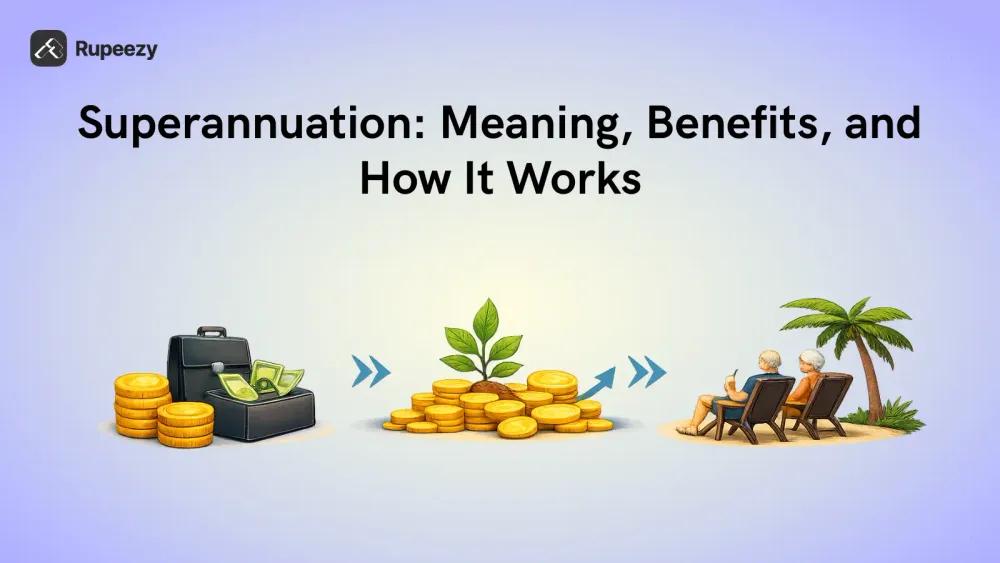
Superannuation is a retirement benefit. It is designed to provide income after a person stops working. It is usually created by an employer. He is the one who makes regular contributions during the employee’s working years. These contributions build a retirement fund over time. Once the employee retires, the said amount is paid back to them. This can be in one lump sum payment or monthly installments.
Key Features of Superannuation
It is a long-term retirement-focused benefit.
Contributions are generally made by the employer.
The amount accumulates over the working life of an employee.
Payout can be received as a lump sum or periodic income.
It helps ensure financial stability after retirement.
Types of Annuities Available Under the Superannuation Scheme
There are various ways through which you can get the superannuation amount. The common ones are:
Annuity Type | What It Means |
Deferred Annuity or Pension | Pension or lump sum gained after a fixed date. |
Payable for Life | A fixed pension in the form of a lifelong income. |
Return of Corpus | Pension is paid for life, and the remaining corpus is returned to the nominee after death. |
Guaranteed for a Fixed Term | Pension is guaranteed for 5, 10, 15, or 20 years, even if the annuitant passes away early. |
Joint Life Pension | Pension continues to the spouse after death, with or without return of the corpus. |
Joint Life With 50% Pension to Spouse | After death, the spouse receives 50% of the pension amount. |
Increasing Pension | Pension amount increases over time to manage rising post-retirement expenses. |
Commutation | A part of the fund is taken as a lump sum, and the rest is paid as a regular pension. |
Pros and Cons of Superannuation
Superannuation has both advantages and limitations. This is one of the most important parts of successful retirement planning. While this is true, there are other reasons as well that make it important. But just like any other financial plan, there are limitations too. You must know both before you plan to invest or save for the same.
Pros of Superannuation
It provides a steady source of income after retirement.
It encourages disciplined long-term savings.
Employer contributions reduce the burden of self-funding retirement.
It offers financial security during non-earning years.
Cons of Superannuation
Access to funds is usually restricted until retirement.
The final amount depends on years of service and contributions.
It may not be sufficient on its own for all retirement needs.
Early exit can lead to lower benefits.

How Superannuation Works
Superannuation follows a clear and gradual process. It is the savings plan that starts during employment and supports an individual after retirement. Therefore, there are various stages that a person needs to go through before they start gaining the benefits. The details of the steps that you must know are:
Step 1: Employer Sets Up the Superannuation Plan
When an employee joins an organization, the employer enrolls them under a superannuation plan. This plan is part of the employee’s retirement benefits. This plan will stay in progress for the entire tenure of your work.
Step 2: Regular Contributions Are Made
The employer contributes a fixed amount regularly, usually every month, into the superannuation fund. In some cases, employees may also add voluntary contributions.
Step 3: Retirement Corpus Builds Over Time
As contributions continue year after year, the total amount grows into a retirement corpus. The longer the service period, the higher the accumulated value.
Step 4: Retirement or Exit From Service
You complete your tenure in the company. The time you retire is when this plan starts working for you. This is where you are now eligible to gain the benefits of the superannuation. This will be in the form that you select.
Step 5: Payout After Retirement
After retirement, the accumulated amount can be taken as a lump sum or converted into a regular income. The payouts will be credited to your account, from where you can use them. This way, the income that you have contributed will start coming back to you.
Example of How Superannuation Works
Anil has worked with a company for 28 years. His employer contributes Rs. 4,500 every month to his superannuation fund. Over time, this builds a retirement corpus. After retirement, Anil withdraws a part of the amount for immediate needs and uses the remaining balance to receive a steady income, ensuring financial stability in his post-working years.
Tax Benefits of Superannuation
Knowing the income tax benefits is important. Tax benefits are an important part of a superannuation scheme for both employers and employees. For employers, contributions to an approved superannuation fund are treated as deductible business expenses.
Contributions up to Rs. 1 lakh are tax exempt. So, if there is any amount that is beyond this limit are taxable. For employees, voluntary contributions qualify for deductions under Section 80C up to Rs. 1,50,000.
Withdrawals at retirement, due to death, injury, or inability to work, and interest earned are generally tax-free.
Difference Between Retirement and Superannuation
The terms retirement and superannuation are often used together, but they do not mean the same thing. Retirement refers to the stage when a person stops working, while superannuation is a financial benefit that supports income after retirement. The table below explains the difference clearly.
Basis | Retirement | Superannuation |
Meaning | The stage when a person stops working permanently. | A retirement benefit that provides income after retirement. |
Nature | It is a life stage or event. | It is a financial scheme or benefit. |
Income Source | Does not automatically provide income. | Provides lump sum or regular post-retirement income. |
Employer Role | No financial contribution involved. | The employer usually contributes regularly. |
Purpose | Marks the end of active employment. | Ensures financial stability after retirement. |
Conclusion
Superannuation plays an important role in building financial security after retirement. It helps employees to get a fixed income even when they're no longer working. However, superannuation alone may not be enough for all retirement needs.
Hence, you ned to have a proper plan of savings with you. Starting with a portfolio can help you greatly. This is where Rupeezy can help you. It allows you compare the options and invest better.
For investors who also invest in eligible stocks, a Margin Trading Facility (MTF) can provide additional buying power by allowing them to pay only a portion of the trade value upfront. However, since MTF involves leverage and interest costs, it should be considered separately from long-term retirement savings.
FAQs
Is superannuation compulsory for all employees?
No. Superannuation is not compulsory. This is based on the choice of the employee.
Can employees contribute to superannuation?
Yes, employees can make voluntary contributions to the fund. This can be based on the tax limit.
When can superannuation be withdrawn?
Superannuation can usually be withdrawn at retirement or after reaching a pre-decided age set under the scheme.
Is superannuation enough for retirement planning?
In most cases, superannuation alone may not be sufficient. It should be combined with other savings and investments.
What happens to superannuation when changing jobs?
Depending on the scheme, the amount may be transferred, withdrawn, or taxed as income from other sources.
Surbhi Bapna is a finance content writer at Rupeezy with more than six years of experience in the finance industry. She holds an MBA degree in Finance from the International Institute of Professional Studies. Surbhi is passionate about integrating finance into people’s daily lives through informative content. She brings in-depth expertise in stocks, personal finance, mutual funds, banking, and investments. Her experience, analytical insights, and commitment to financial research significantly contribute to Rupeezy's comprehensive financial content.
Did you like this blog?
Be the first to like this blog.
The content on this blog is for educational purposes only and should not be considered investment advice. While we strive for accuracy, some information may contain errors or delays in updates.
Mentions of stocks or investment products are solely for informational purposes and do not constitute recommendations. Investors should conduct their own research before making any decisions.
Investing in financial markets are subject to market risks, and past performance does not guarantee future results. It is advisable to consult a qualified financial professional, review official documents, and verify information independently before making investment decisions.





All Category